Expedition captures first images of Shackleton’s last ship, Quest
The wreck of Quest, Shackleton's final ship, has been seen up close for the first time in over 60 years, with images revealing a coral-encrusted hull draped in abandoned fishing nets in the Labrador Sea.
The wreck of Quest – the last ship of the great polar explorer Sir Ernest Shackleton – has been seen up close for the first time in more than six decades, after an expedition led by the Royal Canadian Geographical Society and the Woods Hole Oceanographic Institution obtained the first detailed images of the vessel lying on the floor of the Labrador Sea.
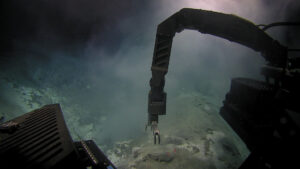
The images were captured using WHOI’s Falcon ROV and DSV Alvin – the same submersible that made the first crewed dive to the Titanic 40 years ago.
The wreck was located 45 nautical miles off the coast of Labrador, where much of it was found to remain intact. In fact, the bow, the deck, and several portholes are still visible, though the entire wreck has since been colonised by pink corals, cod, redfish, and wolf fish.
For expedition leader and RCGS CEO John Geiger, who observed Alvin’s first dive to the site, the moment of encounter was one that resonated deeply. “To see Shackleton’s ship, and to think that Shackleton was standing on that deck a century ago. At first, there was a lot of darkness but suddenly the bow emerges, and you were going towards it. It was incredible,” he said.
Shackleton – the central figure in one of the most extraordinary survival stories in human history, who famously brought his entire crew home alive after the loss of his ship Endurance in the frozen Weddell Sea – died aboard Quest in 1922 at the age of 47, on what was to have been his final Antarctic expedition.
The ship was subsequently sold to a Norwegian family and spent the next four decades sealing in Arctic waters before being crushed by ice floes in the Labrador Sea on 5 May 1962.
The wreck was first located in 2024 by the same RCGS-led expedition, but at that time only side-scan sonar images were obtained. Geiger returned this year with more advanced imaging technology and crewed underwater vehicles to examine the wreck in detail. One of the more sobering discoveries were the large fishing nets found draped across parts of the vessel, obscuring sections of the hull and limiting the team’s ability to survey it fully.
“There is a lot of damage to the ship,” said Geiger. “The nets are a sad story, limiting our ability to look at the wreck. I think we have to take responsibility for what we are doing to our ocean, that’s a huge issue.”

In other news
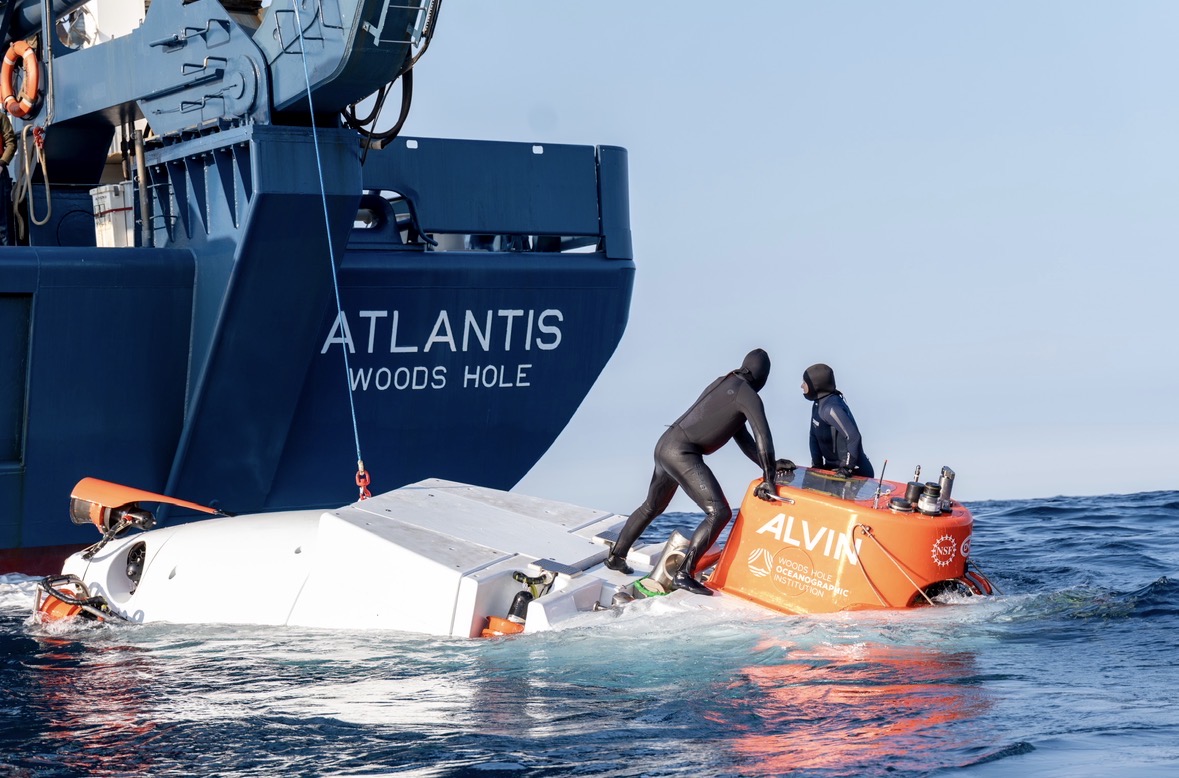
The technical complexity of reaching and documenting the site should not be understated. Alvin submersible pilot Bruce Strickrott, who led the WHOI deep-submergence team, described the operational demands of working at depth around a historic wreck. “Exploring any wreck with a human-occupied submersible is a complicated task,” he said. “Our success today and over the coming days is a direct result of having a group of deep-submergence professionals with extensive experience operating in extremely complicated surroundings.”
Part of the expedition has been to map the entire wreck using breakthrough new underwater photogrammetry technology which generates a permanent digital twin of the site for scientific study as well as public engagement. The technology represents one of the most significant recent advances in deep-sea exploration. Dwight Coleman, Co-Chief Scientist from WHOI, said: “This type of 3D modelling has only existed in ocean science for the last couple of years and it’s giving us entirely new ways to explore these historic wrecks and make them real for the public.”
Later this week, the expedition will sail northeast towards Greenland to survey a second wreck from the same era: Terra Nova, the final ship of Shackleton’s great rival Robert Falcon Scott, who reached the South Pole five weeks after Roald Amundsen’s Norwegian party in 1912 and died on the return journey with four of his men.
The expedition team includes renowned shipwreck hunter David Mearns, marine archaeologist Cora Annamaiya Norling, benthic ecologist Kirstin Meyer-Kaiser and historian Jan Chojecki, author of The Quest Chronicle. Alvin and its support vessel Atlantis are owned by the US Navy and operated by WHOI with support from the National Science Foundation.


"*" indicates required fields
Printed editions
Current issue
Back issues
Enjoy so much more from Oceanographic Magazine by becoming a subscriber.
A range of subscription options are available.
