Krill critical to Southern Ocean's carbon storage, new science finds
Seasonal migration of zooplankton transports around 65 million tonnes of carbon to below 500 metres each year. Most dominant in this process are copepods, which account for 80% of this carbon flux, while krill and salps contribute 14% and 6%.

It’s a process that has, until now, been widely overlooked by all climate models to have preceded it, that the small but mighty zooplankton living in the Southern Ocean – including copepods, krill, and salps – are in fact key players when it comes to the ocean’s ability to absorb and store carbon.
A new study – led by researchers at Plymouth Marine Laboratory – has revealed that zooplankton migration does in fact play a significant role in carbon sequestration; so we should probably start treating it better…
For the first time, the study quantifies exactly how these tiny creatures collectively enhance carbon sequestration through their seasonal, vertical migrations, amplifying the key role the Southern Ocean itself plays in storing carbon, too.
Traditional thinking is that the carbon storage in the Southern Ocean is dominated by gravitational sinking of detritus produced by large zooplankton grazers, such as krill. However, this new research concerns another – more recently described process – called the ‘seasonal migrant pump’. This process sees zooplankton migrate each year from surface waters to depths below 500 metres, storing carbon via their respiration and mortality during their deep ‘overwintering phase’.
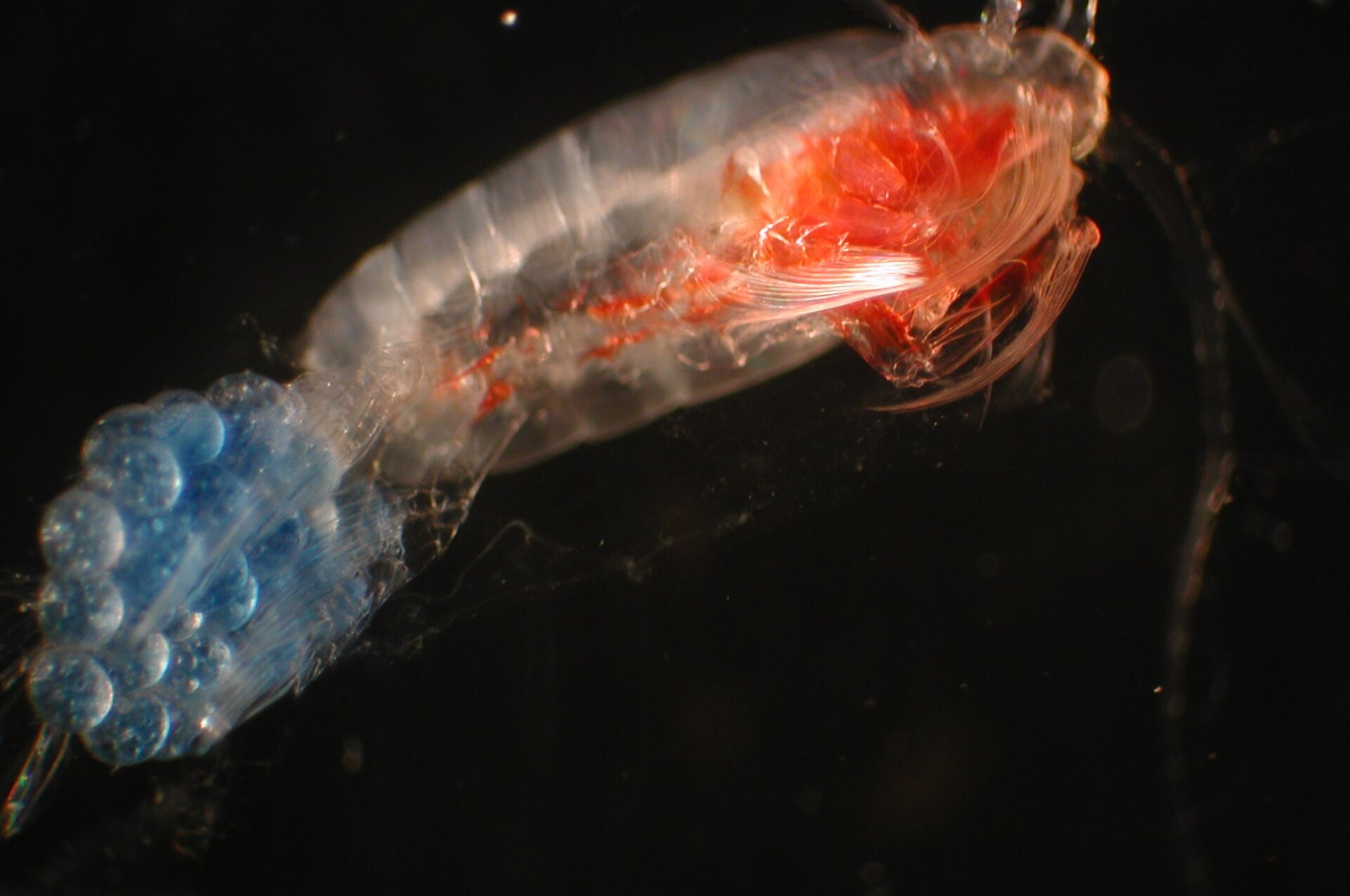
The fact is, this seasonal migration of zooplankton transports roughly 65 million tonnes of carbon to depths below 500 metres each year. Most dominant in this process are the small crustacean called copepods, which account for 80% of this carbon flux, while krill and salps contribute 14% and 6%, respectively.
This has all – until now – been overlooked by current Earth System Models which fail to note the dramatic changes felt in carbon storage dynamics as warming shifts species distributions.
So, why does this ‘seasonal migrant pump’ matter?
Well, the Southern Ocean absorbs approximately 40% of all human-made CO2 taken up by oceans, yet the role of zooplankton in that process has been vastly underestimated. Unlike sinking detritus, which removes both carbon and essential nutrients like iron, migrating zooplankton efficiently inject carbon into the deep ocean while recycling nutrients near the surface.
This ‘seasonal migrant pump’ could become even more important as marine ecosystems respond to climate change.
In other news




Dr Guang Yang, first author and Marine Ecologist from the Institute of Oceanology, Chinese Academy of Sciences, said: “Our work shows that zooplankton are unsung heroes of carbon sequestration. Their seasonal migrations create a massive, previously unquantified carbon flux – one that models must now incorporate.”
This research stresses the urgent need for updates to climate models to include zooplankton-driven carbon fluxes. It also highlights the necessity to manage and protect Southern Ocean ecosystems, where industrial fishing and warming threaten krill populations – a key species that supports both carbon export and Antarctica’s unique biodiversity.
Dr Katrin Schmidt, co-author and Marine Ecologist at the University of Plymouth, said: “The study shows the ‘seasonal migrant pump’ as an important pathway of natural carbon sequestration in polar regions. Protecting these migrants and their habitats will help to mitigate climate change.”
The international study was a collaboration among scientists from China, the UK, and Canada and leverages a century’s worth of data on zooplankton biomass, distribution, respiration, and mortality across the Southern Ocean.
The full paper – Seasonally migrating zooplankton strongly enhance Southern Ocean carbon sequestration – has been published in Limnology and Oceanography.
Dr John Freer, co-author and Ecological Modeller at the British Antarctic Survey, said: “Krill are famous for their role in the Antarctic food web, but we find that copepods significantly dominate carbon storage over winter. This has big implications as the ocean warms and their habitats may shift.”


"*" indicates required fields
Printed editions
Current issue
Back issues




Enjoy so much more from Oceanographic Magazine by becoming a subscriber.
A range of subscription options are available.
