Matters of the heart: what's a blue whale's heartbeat telling us?
New heart-rate data from blue and humpback whales shows their hearts behave like sprinters' during feeding lunges - a discovery that reveals how whales got so big, and how vulnerable their energy budgets really are.
A blue whale’s heart can beat as slowly as two times a minute while it dives – slower than almost anything else alive. Then, mid-dive, it does something nothing like conserving energy – it accelerates to roughly ten miles an hour, throws open a mouth big enough to swallow a small building’s worth of water, and engulfs a school of krill.
Scientists have called it the largest biomechanical event on Earth. And until now, nobody could say what a whale’s heart was doing while it all happened.
But a new study led by researcher Ashley Blawas, with a team including scientists from the Smithsonian Institution, has recorded heart rate through that entire sequence for the first time, in both blue and humpback whales. And interestingly, the pattern bears a striking resemblance to a human sprinter’s heart.
The question itself – what happens to a whale’s heart mid-lunge?’ had gone unanswered for so long not for a lack of curiosity, but for a lack of hardware that actually worked.
“Our technological capacity to put wearable devices on whales in the ocean, and have them work in the same way they work on the everyday person – that is largely an engineering challenge, it’s not a biology challenge,” Blawas told Oceanographic. Before this study, the only successful heart-rate recording from a free-swimming whale in the wild was a single blue whale, tagged and published back in 2019.
Blawas, whose training is in biomedical engineering, was brought onto the project to make the tags more reliable. The result? Nine successful deployments across two species, including the first heart rates ever recorded from a wild humpback whale. The custom-built, non-invasive tags – each about the size of a large phone – attach to a whale’s back with suction cups via a long carbon fibre pole as the animal surfaces to breathe. They then stay on for 12 to 36 hours before floating free to be retrieved. One tag – on a whale off Antarctica – stayed attached for almost three days.
“It was really cool because that record had a bunch of different behavioural data on it,” said Blawas. “You just get a better view into the life of these animals.”
During a dive, heart rate falls as low as roughly six to seven beats per minute in blue whales. But immediately after a lunge, it spikes – and unlike almost every other diving heart-rate pattern recorded in animals, it doesn’t drop back down quickly. It stays elevated through the low-effort filtering phase that follows, when the whale is mostly gliding as it pushes water out through its baleen.
“This is similar to what we see in the heart rate patterns of humans doing interval sprints – almost identical,” said Blawas.

In other news




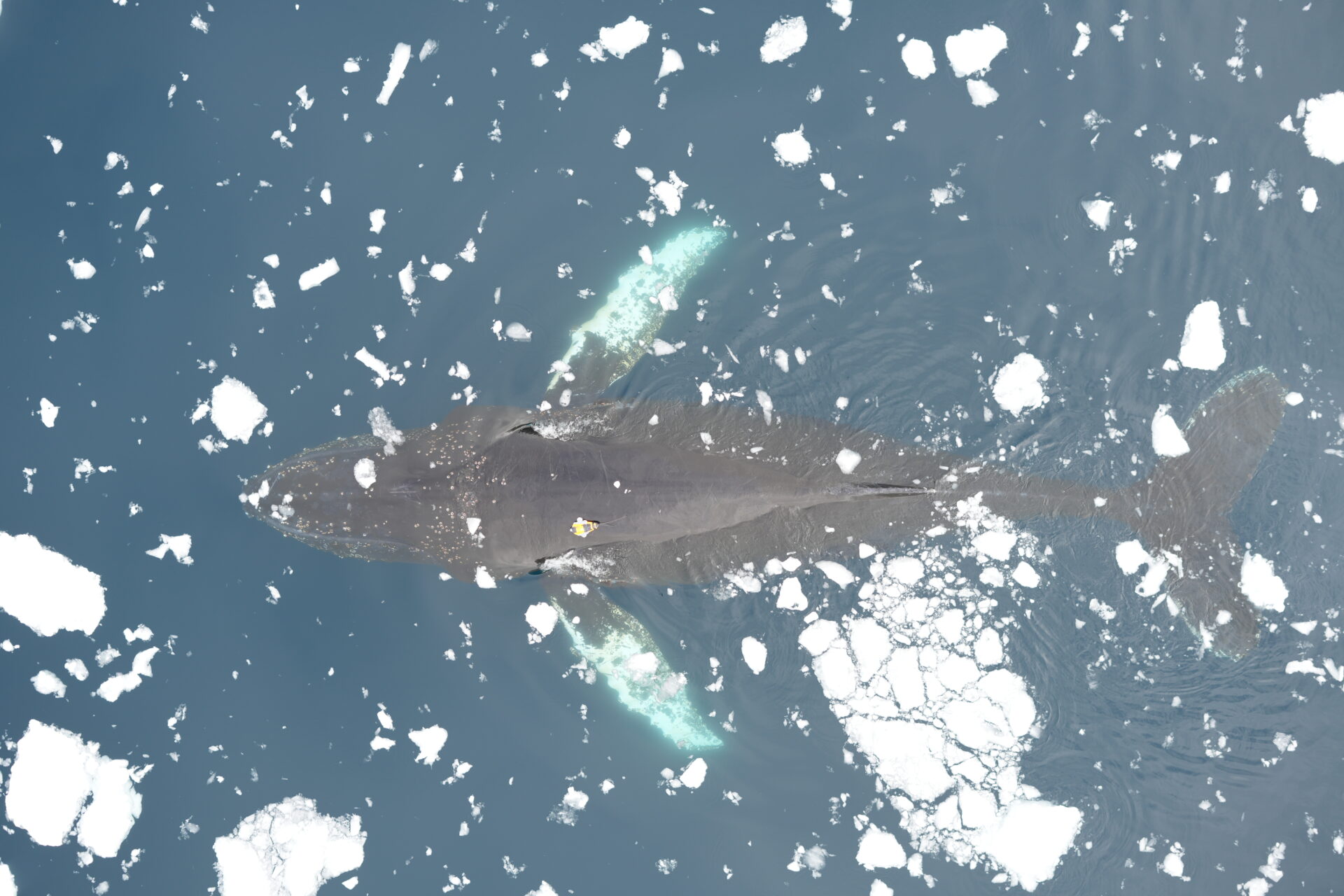
The study found that heart rate immediately after a lunge jumped to around 22 beats per minute in blue whales and 28 in humpbacks, easing back down over the roughly 60 seconds it takes blue whales to filter, or 17 seconds for humpbacks.
The likely explanation is that a lunge is too fast and too powerful to run on oxygen-fuelled metabolism alone. “These animals are probably not powering those sprints using only aerobic energy stores, likely because they are too powerful, they just can’t get enough oxygen to the muscle in that short bit of time,” said Blawas.
The study points, instead, to anaerobic pathways – the same ones human sprinters rely on – with the elevated heart rate during the glide helping resupply oxygen and restore energy stores before the next lunge.
Comparing the two species, the researchers also found that blue whale operate across a far wider heart range than humpbacks at roughly six to seven times the difference between their lowest and highest heart rates, compared to about three in humans. Blawas calls this ‘heart rate scope.’
“These really responsive, flexible heart rates that are highly tuneable are important for efficiently matching the demands of exercise,” continued Blawas. “This idea that rorquals have this larger heart rate scope maybe allows them to tune their oxygen supply to a greater degree than many a human, or a smaller terrestrial or marine mammal, might be able to.”
It’s a pattern that has never been documented in the ocean before, and one that suggests that a flexible heart may be one of the physiological keys that let whales grow so large in the first place, idling cheaply for most of a dive, while still able to summon an explosive sprint on demand.
Existing research already shows that rorquals feed harder when prey is dense, and stop bothering when it isn’t.
“If we think of it as, for example, maybe a prey patch becoming sparser, it’s like our willingness to go to a poorly stocked grocery store… you’re just not going to go if it doesn’t have most of the things you’re looking for,” Blawas explained. As ocean warming and shifting currents alter where krill aggregate, that threshold behaviour might start to alter, too. Whales operating this close to their energetic limits may simply abandon a thinning patch rather than adapt to it.
The tagging technology developed in this study also points towards what Blawas has called “whale wearables” – tags that could track an individual whale’s heart rate and stress levels over much longer periods, including its response to an approaching ship or loud underwater noise.
“We want to get these tags to the point where we can put them on whales and measure heart rate over long periods of time, and study variables like an individual’s resting heart rate, or its heart rate variability, or changes in heart rate when it’s exposed to a boat that might approach it.”
For whales that share feeding grounds with shipping lanes, that kind of data could help shape how human activity is managed around them.
For Blawas, the headline finding is simpler than any of this.
“I think, for the first time, we show that the largest animals on the planet have unique cardiac functions – they have really flexible heart rates – that allow them to perform these sprints underwater,” she said. “These animals are fascinating, and people are at baseline fascinated by them because they are so big and seem so different. But actually, they’re not. They share all the same mammalian systems that we have.”


"*" indicates required fields
Printed editions
Current issue
Back issues




Enjoy so much more from Oceanographic Magazine by becoming a subscriber.
A range of subscription options are available.
