Mexico told: "reverse vaquita protection rollback" as CITES reviews
An open letter to President Claudia Sheinbaum warns that a new Decree leaves the world’s most endangered small cetacean exposed to gillnets, with only 5 to 13 individuals remaining.
Nearly one hundred national and international civil organisations and specialists have signed an urgent letter to Mexican President, Claudia Sheinbaum, demanding the immediate reversal of a Decree that has left more than 80% of the vaquita marina’s protection zone open to gillnets.
The letter, led by Mexican NGO Conservacion de Mamiferos Marinos (COMARINO) with the support of Centro de Conservacion Cetacea (CCC Chile), comes as the Convention on International Trade in Endangered Species of Wild Fauna and Flora (CITES) turns to a formal review of the measures Mexico has adopted under its Compliance Action Plan.
The review begins this month, and the letter will be presented to the CITES Secretariat when it does.
At the end of last month, Mexico introduced a Decree that reduces the protection zone given to the last remaining population of vaquita (thought to be just ten) to just 225 kilometres with no buffer zones, cutting the gillnet prohibition area by approximately 86%. Recent scientific data indicates that only between five and 13 vaquita remain, and that incidental capture in gillnets is the only significant threat to their survival.
The letter points out that in August 2023, the International Whaling Commission (IWC) issued its first Extinction Alert in more than 80 years of existence. The mechanism, created by the IWC Scientific Committee, is only activated when scientific evidence shows that a species or population of cetaceans faces an imminent risk of disappearing.
Organisations opposed to Mexico’s Decree state that “the fact the vaquita marina was the first and only species to receive an Extinction Alert since the IWC’s founding in 1946 irrefutably evidences the extreme severity of its conservation status, and ignoring it would constitute a historically unforgivable act of negligence.”

In other news

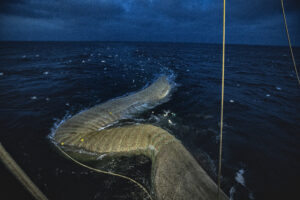

As well as shrinking the protected area, the Decree creates a 350-metre-wide transit corridor through the Zero Tolerance Area, a space that until now was strictly off-limits to both maritime traffic and fishing. The signatories say the corridor not only undermines surveillance efforts but could also give illegal vessels access to the most critical zone for the species’ survival.
It also authorises gillnet fishing outside the reduced area and – rather than establishing buffer zones – creates an adjacent “Special Use Zone” and further shortens the nighttime fishing ban. It brings gillnets right up to the boundaries of the small Zero Tolerance polygon and splits it in two.
The signatories state that “far from protecting the vaquita marina, these measures exponentially increase the risk that the last remaining individuals will become entangled in nets and die, precipitating the definitive collapse of the species.”
The vaquita has been driven to the brink of extinction by the totoaba (Totoaba macdonaldi) fishery. The totoaba is itself critically endangered, and its swim bladder is highly valued on the black market in Asia, primarily in China.
A report by the UK’s Environmental Investigation Agency (EIA), cited in the letter, revealed that the illegal trade in totoaba swim bladders remains active and is growing on social media platforms. NGOs and specialists state that “because the totoaba and the vaquita marina are similar in size, it is impossible to fish totoaba with gillnets without endangering the vaquita, so any permissiveness is a death sentence for the vaquita marina.”

The letter warns that if the vaquita goes extinct, Mexico will become the second nation, after China and the baiji dolphin, to allow a cetacean species to disappear forever. “This legacy of extinction would be an indelible stain on the country’s environmental reputation,” the letter states.
It also underscores Mexico’s international commitments under CITES, the IWC, the International Union for Conservation of Nature (IUCN) and UNESCO. In 2026, UNESCO reiterated its utmost concern over the species’ critical status and warned that sightings continue to occur outside protected areas.
The letter, which the organisations say collectively represents the will of millions of people around the world, asks President Sheinbaum’s government to:
- immediately reverse the weakening of protection measures
- strengthen law enforcement to ensure compliance, and dismantle illegal fishing and ghost nets
- combat the illegal totoaba trade by collaborating with other countries and demanding that social media platforms immediately remove advertisements for totoaba products
- implement and finance fishing alternatives
- restore scientific monitoring by facilitating scientists’ access to the vaquita’s habitat
The signatories conclude that “extinction is the ultimate expression of the bankruptcy of a social system that, by allowing the continued disappearance of the planet’s biodiversity, leads us toward our own self-destruction,” and therefore “deregulation is neither a legal nor an ethical option in the face of the threat of extinction” of this species.


"*" indicates required fields
Printed editions
Current issue
Back issues
Enjoy so much more from Oceanographic Magazine by becoming a subscriber.
A range of subscription options are available.