Whale song hints when endangered pygmy blue whales are feeding
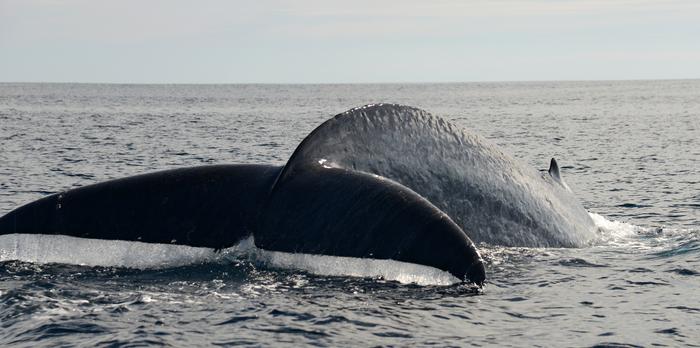
A new Curtin University-led study, published in Royal Society Open Science, found that pygmy blue whales generally feed during daylight hours, leaving more time available for singing at night.
Listening to the songs of endangered pygmy blue whales could help researchers identify when the animals are feeding off Western Australia’s coast, improving scientists’ ability to monitor their behaviour and inform conservation efforts.
A new Curtin University-led study, published in Royal Society Open Science, found that pygmy blue whales generally feed during daylight hours, leaving more time available for singing at night. During the whales’ feeding season in Perth Canyon, more song was recorded at night than during the day for up to three months.
The findings suggest that listening for differences between day and night song could offer a way to track feeding activity across large areas of ocean, without the need to observe the whales directly.
The research examined pygmy blue whale singing and feeding behaviour in offshore waters from Perth Canyon, along WA’s Midwest coast, and further north towards Ningaloo and the Northwest Shelf.
Lead author Andrew Davenport, a PhD candidate at Curtin’s Centre for Marine Science and Technology, says the relationship between feeding and singing offers a valuable new way to understand the behaviour of this endangered population.
“Just as we can’t talk while we’re eating, pygmy blue whales appear to have less time available to sing while they’re feeding,” said Davenport. “By listening to when they sing more at night than during the day, we can infer when whales in an area are likely to be feeding.”

In other news


The research, Pygmy blue whale feeding drives greater nocturnal than diurnal song production, is available to read in Royal Society Open Science.
Audio of pygmy blue whale song and non-song vocalisations is available via the Centre for Marine Science and Technology. The recordings were not made during this study, but feature the same song type and were captured during earlier research by Davenport and his CMST colleagues.


"*" indicates required fields
Printed editions
Current issue
Back issues



Enjoy so much more from Oceanographic Magazine by becoming a subscriber.
A range of subscription options are available.