Record grey seals count a conservation success for South Walney
Officials at Cumbria Wildlife Trust have called this season’s count a "landmark result" for the charity who can now hold the growth of the grey seal colony at South Walney up as a “great conservation success story.”

It’s been a record year for grey seal populations at the South Walney Nature Reserve near Barrow in the UK where numbers have just reached a total of 563 seals counted, marking an upward trend for the species that was last counted at 518 in 2021.
Officials at Cumbria Wildlife Trust have called this week’s count “wonderful news” and a landmark result for the wildlife charity who can now hold the growth of the grey seal colony at South Walney up as a “great conservation success story.”
The total counted this season is a stark increase on the 360 counted back in 2018 and the 483 in 2019, and indicates an upwards trend in population numbers.
“The colony has grown from single figures in the 1980s and ‘90s and now we have exceeded our previous highest count by nearly 50,” said Beth Churn, marine conservation officer for Cumbria Wildlife Trust.
Seal population numbers on South Walney Nature Reserve are measured by flying a drone – at great height and under permission of Natural England – to avoid distressing the seals and other wildlife in the area. It’s a method that has been used for getting an accurate count on the grey seal population in the area for the last few years.
In other news


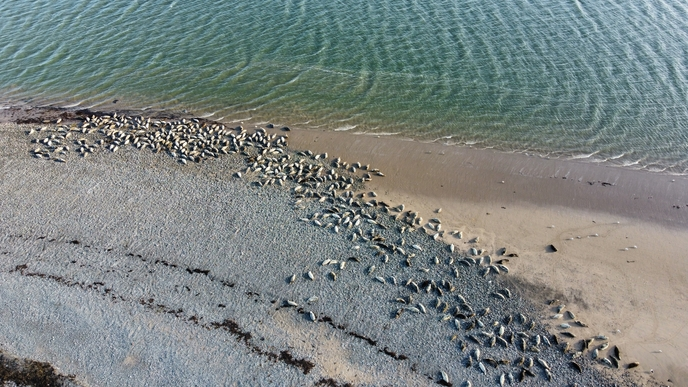
“It’s a great resource for us to use, although we’re continuing with our traditional surveys, which involve us crawling across the shingle and watching the seals through binoculars to compare counts and record their behaviour,” said Beth. “Both methods are important but the drones give us more accurate numbers.”
Grey seals at South Walney Nature Reserve are quite the success story. Just ten years ago, the colony there was a non-breeding colony and the seals found there were typically older bulls. Back in 2015, however, two fluffy white pups made history as the first grey seal pups to be born on the remote Irish Sea island. Since then, the number of pups has been increasing year-on-year and the island now hosts an active breeding colony.
Eager to share the success of the conservation effort with the Cumbrian public, South Walney has set up a sealcam to enable them to watch the seals in action while maintaining a distance designed to keep the seals safe.
Globally, the grey seal is one of the rarest seal species with about 50% of the world population living in British and Irish waters. Grey seals often feed around rocky coasts, sheltered coves, clear waters, and sandy bays of offshore islands, such as South Walney.
They will typically come ashore to breed from late September until December. At South Walney Nature Reserve, the grey seal counting season runs from September to March.


"*" indicates required fields
Printed editions
Current issue
Back issues


Enjoy so much more from Oceanographic Magazine by becoming a subscriber.
A range of subscription options are available.
