Scientific study "blows apart" Faroe Islands' defence of the grind
A new scientific review challenges the Faroese authorities' central defence of the grindadráp, finding that abundance estimates alone cannot justify the removal of entire pilot whale family pods and maternal lineages.
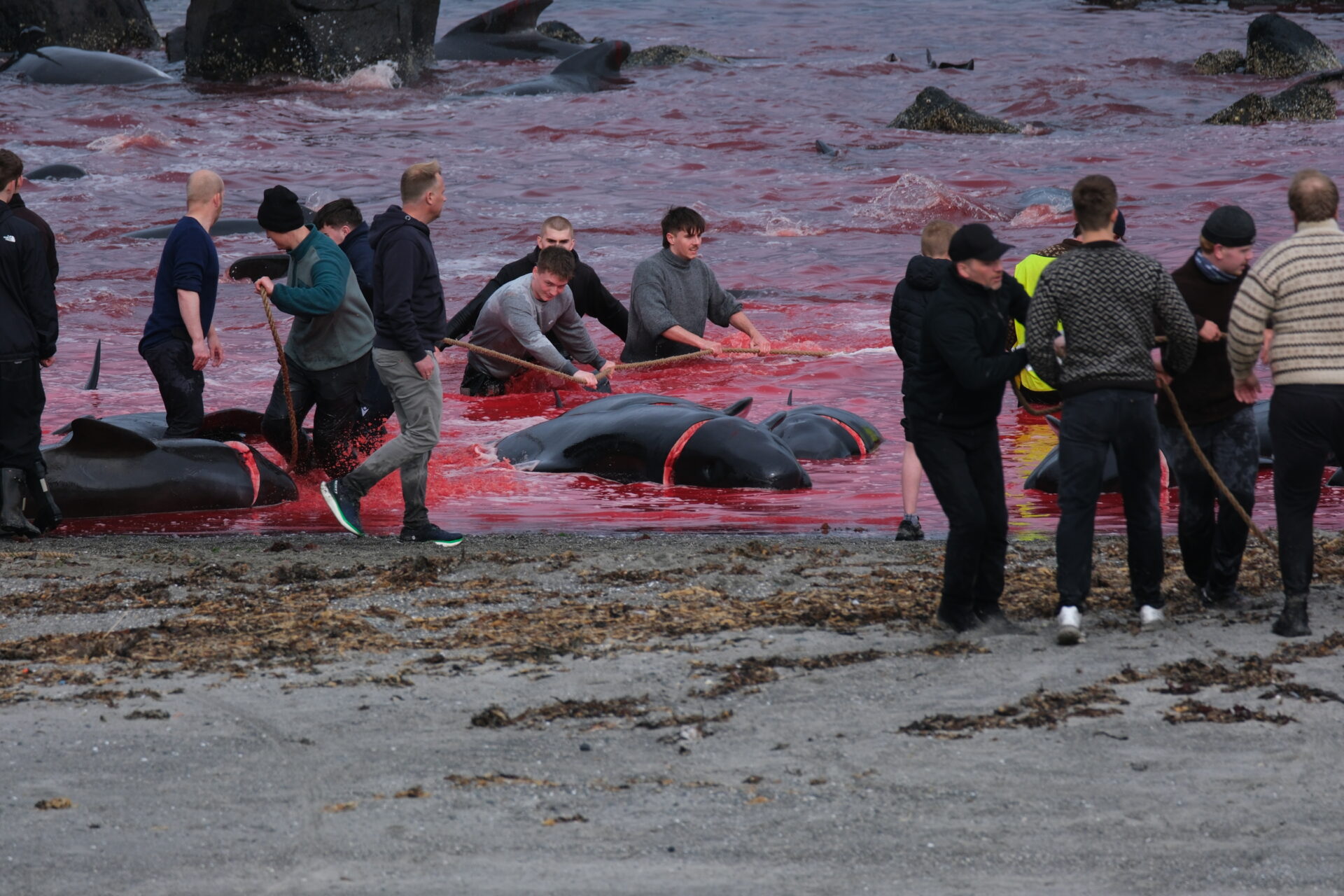
More than 700 dolphins were killed in a single day in the Faroe Islands last month. When whalers ran out of equipment, multiple dolphins were reported to have been driven over by boat propellers before being forced to the shoreline to be slaughtered. The scenes drew global condemnation.
Now, a landmark scientific review has called into question the core argument – that the hunt is a sustainable practice – used to defend them.
Published in Frontiers in Marine Science and authored by independent marine researcher Lavinia Mitchell and co-authored by Nina Young, the report exposes a fundamental flaw in the Faroese authorities’ central justification for the grindadráp: that because long-finned pilot whales remain numerous across the North Atlantic, the killing of entire pods is sustainable.
Counter to this, the authors argue that abundance estimates ‘say nothing about whether specific family groups, maternal lineages or biologically meaningful population units can withstand repeated, wholesale removal.’
Fundamental to the research is the finding that pilot whales live in tightly bonded family groups structured around maternal lines, with social knowledge – such as feeding strategies, migratory behaviour, and group cohesion – passed down through generations within those units. When a grind drive hunt eliminates an entire pod, it does not remove a representative sample from a broad population. It erases a family.
“The key scientific question is scale,” said Mitchell. “A broad abundance estimate may tell us something about the wider species, but it does not necessarily tell us whether specific family groups, maternal lineages or biologically meaningful units can withstand repeated removals.
“If a hunt removes an entire pod, it may remove far more than a set number of animals. It may remove a family unit, a maternal line and the social knowledge carried within that group. That is why abundance alone is not enough.”

In other news


The review synthesises current evidence on population structure and genetic connectivity among North Atlantic long-finned pilot whales, and identifies a critical gap at the heart of existing management approaches. While large-scale surveys estimate more than 100,000 long-finned pilot whales in the eastern North Atlantic and approximately 253,000 across surveyed regions, these figures describe numbers and not demographic independence.
Recent genetic studies suggest regional structuring within the North Atlantic population, but sampling remains uneven and data linked directly to hunted individuals is limited. As a result, it is currently impossible to determine how removals in the Faroe Islands are distributed across what scientists call demographically independent populations – units whose survival depends on internal recruitment rather than immigration from elsewhere.
In a species characterised by stable matrilineal social organisation, the loss of entire social units carries consequences for recruitment, genetic diversity and long-term demographic resilience that species-level abundance figures simply cannot reveal.
The report calls for post-mortem genetic sampling of hunted animals as a practical step toward reducing that uncertainty – and toward building a sustainability assessment that operates at the scale that actually matters.
The Faroe Islands lie just 200 miles north of Scotland. The grindadráp, which has taken place there for centuries, kills both pilot whales and Atlantic white-sided dolphins. Defenders of the practice have long pointed to broad population estimates as evidence that the hunts pose no meaningful conservation risk – a position now under direct scientific challenge.
Valentina Crast, Campaign Director of Stop the Grind, said the findings “blow apart one of the most persistent myths used to defend the grind,” – that because pilot whales are numerous, wiping out entire family pods is somehow justified.
“Science is now telling us what environmental advocacy groups have long argued,” she said. “What is being lost in these hunts goes far beyond numbers. It is entire families, lineages and knowledge that can never be recovered. The Faroese authorities can no longer hide behind abundance estimates. The evidence demands that these hunts must end once and for all.”
The central conservation question, the report concludes, is not whether long-finned pilot whales remain abundant at a regional scale. It is whether recurrent removals can be evaluated against the population units that determine recruitment, lineage persistence and long-term resilience.
Without that resolution, the authors argue, it is impossible to assess whether the grind is compatible with the long-term maintenance of biodiversity.


"*" indicates required fields
Printed editions
Current issue
Back issues

Enjoy so much more from Oceanographic Magazine by becoming a subscriber.
A range of subscription options are available.
