Once unable to swim and scared of the ocean, Hoksbergen has quickly risen to professional acclaim. She brings a careful, patient eye and an artistic flair, which allow her to showcase the often overlooked details of the ocean; her work inspires empathy, drives discovery and spurs greater environmental action.
OCEANOGRAPHIC (OM): How did you first connect with the ocean, and how has your relationship with the ocean grown?
Jade Hoksbergen (JH): “I was born in Taiwan, a small island nation completely surrounded by water. My relationship with the ocean was non-existent at that point. In Taiwan, we are raised to be afraid of the sea. We have very violent coastlines, and the drowning deaths per year is really high. So as a nation, we see how powerful that it is – the sea is serious, it’s not for fun.
Then my parents and I moved to Cebu, in the Philippines. It’s a wonderful country, an archipelago, a constellation of different islands. My relationship with the ocean really started there. When we first moved there, I couldn’t swim at all, but I was an only child and taught myself when I was bored in the swimming pool in our house.
My dad started scuba diving on the recommendation of his sister, and he got really into it. He insisted on showing me Finding Nemo and we’d always watch it together.
He’d say: “The sea, it’s really like that, this isn’t just a cartoon!”
I couldn’t believe it. Then, when I was nine, he took me for my first dive in two metres of water. We saw a clown fish – so we saw Nemo – on the first dive…and my mind was completely blown. That’s how I started scuba diving.
I kept diving from then on and, especially in my teenage years, it felt like meditation. The sea was very much a very comforting place, and it was really important to me. I went on to complete more diving qualifications and by the age of 20 I got my divemaster qualification.”
OM: And how did that love of diving translate into pursuing ocean photography?
Jade Hoksbergen: “I met Henley (Spiers), my now husband, when we were young. We were doing long distance while I was at university studying psychology. I decided to put a pause on my studies, and to go and join him in St Lucia, in the Caribbean. He was working as a dive instructor, and I decided to do my divemaster course.
Henley had a camera already at home, and he was interested in underwater photography, but he hadn’t given it a proper go yet.
I borrowed it and began to photograph the mesmerising patterns of brain coral and species IDs to help with my personal hobby of logging my dives. Then I began to notice some really rare things, things I had never seen – nor the dive professionals on the island: gaudy clown crabs tucked inside tube sponges, a pygmy pipehorse smaller and thinner than a toothpick, a medusa blenny crowned with the most elaborate cirri.
I started to realise that some of the creatures that I found that were obviously special to me, were also special to the locals. And that’s when I thought, wow, okay, I need to photograph these wondrous animals and show them to people. It really was by accident.”
OM: And so from these early photos, how did you develop your own photography style?
Jade Hoksbergen: “I’ve painted since I was young, and my dad encouraged me to not care about what things should look like – to just paint what I felt and my interpretation of things. When you go to art school, sometimes they teach you so much technique that you lose your individuality and style.
So when it came to photography I didn’t really operate by any rules. I would have very strange compositions – the fish would be on a diagonal, and I’d only capture half of its face. Henley and I loved reviewing pictures together, and he would find this really strange. He would say: “Why is your composition so weird?”
For me, I didn’t really care about what others were doing and what the rules were. If it looked cool to me, that was fine, and I was quite happy experimenting and playing around.”
More Behind the lens

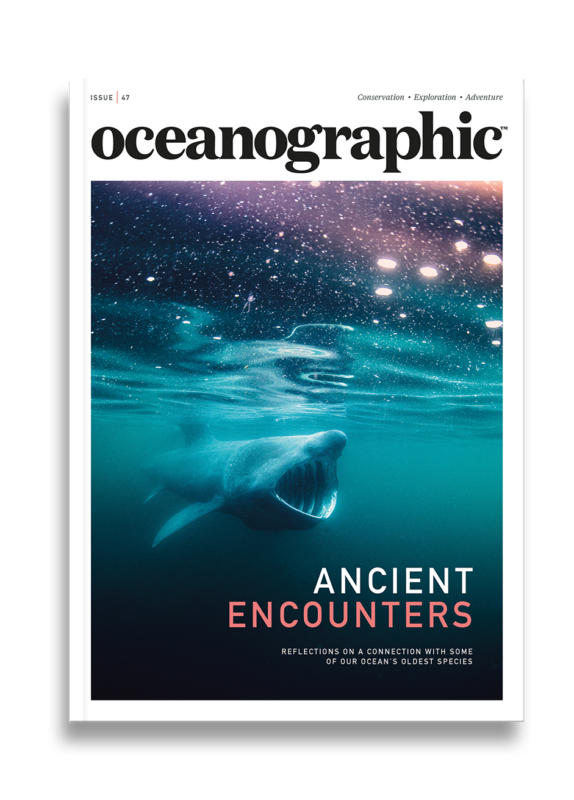

This interview appears in ISSUE 47: ANCIENT ENCOUNTER of Oceanographic Magazine
Continue reading
This story is exclusively for Oceanographic subscribers.
