Blue whales are mapping the ocean's temperature to find food
Blue whales don't find krill swarms by chance - new research shows they track thermal fronts, narrow bands of sharp temperature change, using a sensory strategy that could apply across many predator species.
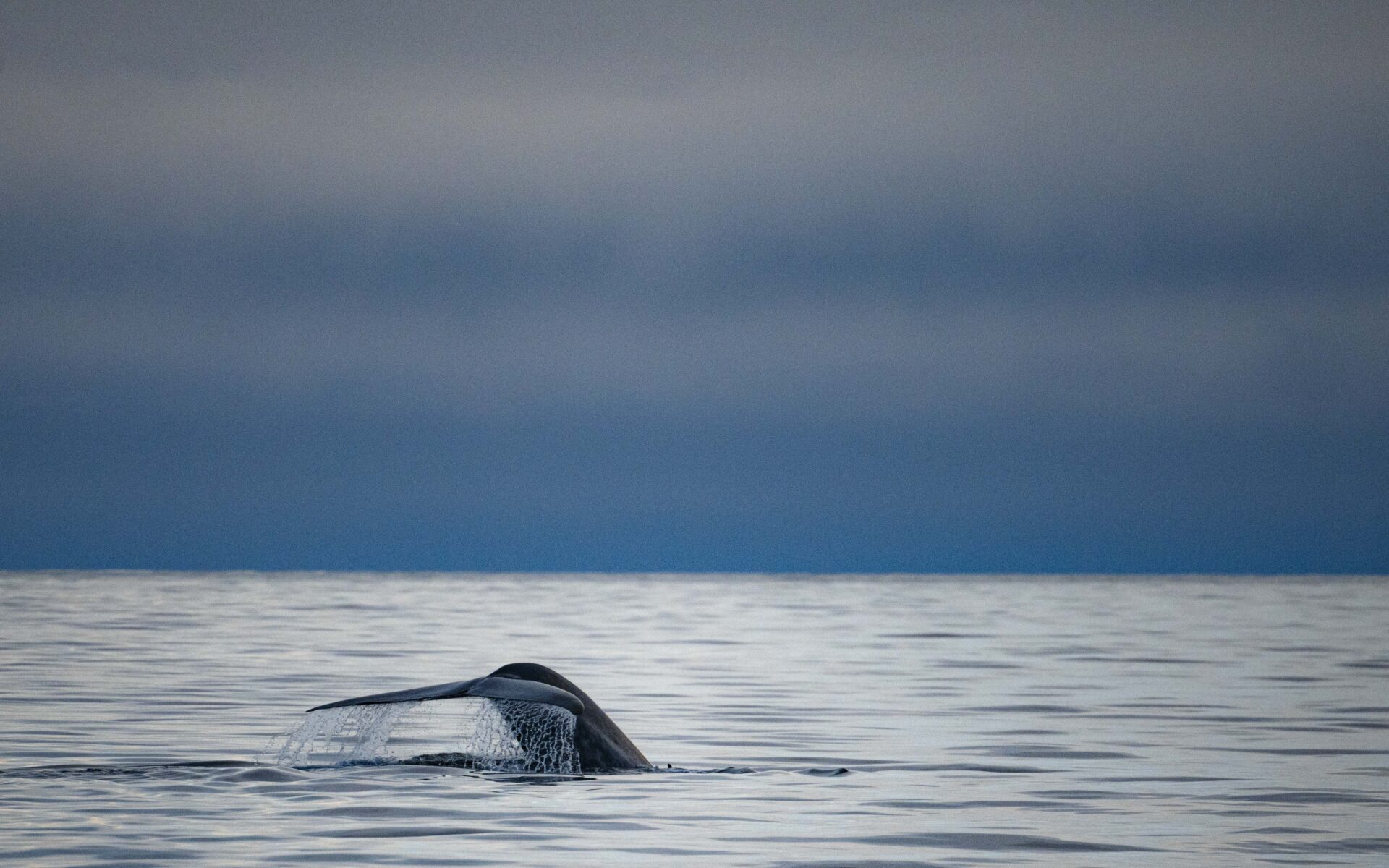
Blue whales – the largest animals on Earth – need dense swarms of krill to justify the enormous energy cost of feeding. New research shows that they do not simply stumble across these swarms, but home in on narrow bands of the ocean where temperature shifts, effectively using them as a guide to the richest hunting grounds.
The study – published in the journal Current Biology and led by MBARI biological oceanographer John Ryan, combined data from electronic tags attached to whales with satellite observations of the ocean surface to map – for the first time – how the animals navigate towards prey.
“We know they need very dense swarms of krill to make the intensive effort of feeding worthwhile, but krill swarms can be difficult to find in the vast ocean,” said Ryan. “Our team wanted to learn more about how these giant animals locate krill swarms. Do they sense them directly, or do they sense specific conditions in the ocean environment that guide them to krill swarms?”
To answer that, researchers from MBARI’s Blue Whale Observatory worked with collaborators at Cascadia Research Collective and Stanford University who deployed biologging tags on whales in the Monterey Bay region to record their movement, activity levels, and feeding behaviour, alongside the ocean conditions around them.
This data was then paired with reading from satellites carrying radar altimetres and NOAA infrared thermal sensors.
Piecing the datasets together revealed a consistent pattern: the whales concentrated their feeding along thermal fronts – the narrow zones where ocean temperature changes sharply. They would locate a front near the surface, dive deep to search for krill, and move from the cooler side of the front toward the warmer side as they hunted – feeding intensively once they found a swarm.
“The whales’ responsiveness to thermal fronts occurred day and night, with or without the result of successful feeding. The precise, systematic movement behaviours of blue whales tell us that they cannot only sense temperature, but also track where and how temperatures change near the ocean surface, suggesting a remarkable capacity for memory, comparison, and orientation,” Ryan continued.

In other news



The finding points to a previously undocumented dimension of blue whale sensory perception, one Ryan believes may well extend beyond this one species alone.
“This discovery has broader implications for understanding many species that rely on dense prey aggregations to survive. It opens the door to explore whether this is a fundamental foraging strategy across diverse predator species, enabling them to precisely localise feeding effort where prey are most concentrated,” he said.
Meanwhile, for an endangered species whose feeding grounds regularly overlap with shipping lanes, the discovery enables researchers and conservationists to support the protection of blue whales through a greater understanding of how they live as well as how their lives intersect with human activities that unintentionally threaten the whales.
“As they went about their lives consuming tonnes of krill, these foraging blue whales moved through habitat that is regularly transited by gigantic ships,” said Ryan.


"*" indicates required fields
