ClientEarth takes Spain to court over whale and dolphin bycatch
Legal action seeks effective monitoring and mitigation measures to stop the incidental deaths of cetaceans in Spanish Atlantic waters, where at least 2,000 may be caught each year in Galicia alone.
An environmental law firm is taking legal action against Spain for failure to respond to requests for better and more effective measures in monitoring, preventing and reducing the number of incidental deaths of dolphins, porpoises, and whales within Spanish Atlantic waters.
Recent research has uncovered that at least 2,000 cetaceans may be caught accidentally in fishing gear each year in Galicia alone.
In July this year, ClientEarth sent a formal letter to Spain’s Ministry of Agriculture, Fisheries and Food calling for urgent action to address the ongoing incidental capture of cetaceans in Spanish Atlantic fisheries.
The submission argued that Spain is still failing to implement the monitoring and conservation measures required under European law to assess and reduce marine mammal bycatch in the Cantabrian and North-Western fishing grounds, particularly in the waters off Galicia.
It urged the authorities to strengthen monitoring systems, improve data collection, and adopt effective prevention and mitigation measures. But, with no response from the authorities, the organisation has taken the matter to court.
The waters off north-west Spain are among the most productive fishing grounds in Europe, supporting both significant fishing activity and an important diversity of marine mammals. All together, some 28 cetacean species have been recorded in the region.
However, bycatch – the capture of non-target species in fishing gear – is widely recognised as one of the most serious threats facing cetaceans in European waters. Scientific evidence has consistently identified it as the primary human-induced pressure on several species, including common dolphins, bottlenose dolphins and harbour porpoises. The common dolphin, the most abundant cetacean in the north-east Atlantic, is also the species most frequently affected.

In other news




Despite years of scientific warnings and concerns raised by the European Commission, ClientEarth says Spain still lacks sufficiently robust monitoring systems to assess the true scale of the problem, and has failed to adopt adequate measures to reduce these incidental captures.
To this end, it stands quite apart from its geographical neighbours; nations with stronger monitoring and prevention tools in place.
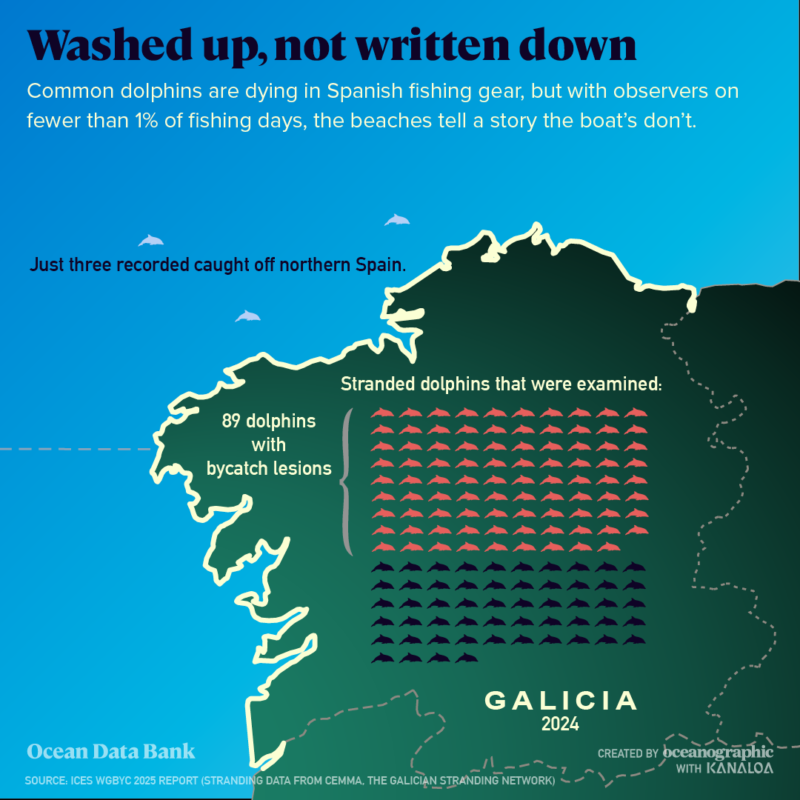
Figures from the International Council for the Exploration of the Sea’s (ICES) Working Group on Bycatch of Protected Species (WGBYC) 2025 report give a sense of how thin that monitoring is, and how it compares with neighbouring countries.
Spain monitored just 0.46% of its fishing days, or one day in every 216. Portugal monitored 0.98% (one day in 102), France 1.32% (one in 76) and the UK 0.62% (one in 160).
According to the ICES WGBYC 2025 report, Spain has run electronic monitoring (EM) trials, but the data were not submitted.
Meanwhile, cetacean mortality linked to fishing activities remains alarmingly high. Gaps in data collection make it difficult to determine the full extent of the issue, but available estimates suggest at least 2,000 cetaceans may be caught each year in Galician waters.
ClientEarth is asking the Spanish authorities to:
- implement monitoring specifically aimed at assessing the presence and scale of cetacean bycatch, as a priority
- promptly adopt effective prevention and mitigation measures based on the best available scientific evidence
- activate the necessary funding mechanisms to implement these measures wherever bycatch poses a threat to cetacean populations
Arthur Meeus, lawyer at ClientEarth, said: “The legal framework to protect cetaceans exists, but it must now be implemented. States have an obligation to properly monitor these incidental catches and adopt effective measures when they pose a conservation risk to protected species. Spain must now turn its legal commitments into concrete measures and effectively reduce this avoidable cetacean mortality.”
Meeus added: “Protecting dolphins, porpoises and other cetaceans is not only an environmental imperative; it is a legal obligation. But protection without monitoring is meaningless. Without robust monitoring, authorities cannot accurately assess the scale of bycatch, nor can they design effective solutions. Spain must act now to ensure that fisheries operate in a way that safeguards protected marine species, as required by the best scientific recommendations.”
Spain is subject to numerous legal frameworks that require it to monitor, assess and reduce the incidental capture of protected marine species, and to ensure that it does not compromise their conservation status.
Campaigners argue that the longer Spain waits to meet these responsibilities, the greater the long-term socio-economic costs will be, as continued inaction will ultimately require stricter conservation measures.
“Reducing bycatch of protected species is both achievable and necessary,” added Meeus. “The science is clear, the legal obligations are clear, and the tools already exist. What is needed now is implementation.”
The case follows years of pressure on Spain over the issue. In 2019, ClientEarth and other organisations submitted a complaint to the European Commission alleging that several Member States, including Spain, were failing to comply with their obligations to protect cetaceans from bycatch.
The Commission subsequently opened infringement proceedings and concluded that Spain had failed to adopt sufficient monitoring measures and had not made full use of the tools available under EU legislation to protect these species.
In 2020, the International Council for the Exploration of the Sea (ICES) recommended improving data collection, implementing mitigation measures and introducing temporary fishery closures in specific areas and periods to reduce cetacean mortality to sustainable levels.
Spain is currently developing a Royal Decree on the protection of cetaceans, marine turtles and seabirds from bycatch in fisheries. ClientEarth considers the legislation an important opportunity to strengthen protection for these species, but says it must fully align with obligations under EU law and be accompanied by effective implementation and enforcement mechanisms.


"*" indicates required fields
Printed editions
Current issue
Back issues

Enjoy so much more from Oceanographic Magazine by becoming a subscriber.
A range of subscription options are available.