Concrete towers on the seabed scupper Cambodia's illegal trawling
Marine Conservation Cambodia has reached a 25% milestone in deploying seabed structures that deter illegal trawling and rebuild fish stocks - with early monitoring recording six times more fish at protected sites than control areas.
Cambodia’s coastal waters have been in trouble for years. Illegal bottom trawling has stripped fish from habitats that coastal communities have depended on for generations, damaging critical marine ecosystems and threatening the long-term viability of small-scale fisheries across the country’s four southern provinces.
But after decades of relatively light action, finally the Cambodian government – working in partnership with Marine Conservation Cambodia (MCC) and local fishing communities themselves – has landed on a simple, yet effective, response. And it involves placing large, heavy structures on the seabed – the kind that marine life can colonise yet trawl nets cannot move.
Known as Fishery Productivity Structures (FPS), these structures are octagonal concrete towers assembled underwater by trained dive teams from 130-kilogram individual blocks. Weighing in at two to three tonnes each, they are heavy enough to remain stable when trawl nets catch on them, entangling and disabling the gear. They are also complex enough in their architecture to provide shelter, feeding habitat and nursery space for a wide range of marine species.
Above all else, however, they are -as the monitoring data is beginning to show – effective.
MCC has now deployed 1,250 FPS structures across southern Cambodia as part of the Sustainable Coastal and Marine Fisheries (SCMF) Project – a government-led initiative funded by the Asian Development Bank and Agence Française de Développement.
The figure represents 25% of the project’s overall target, a milestone that marks two years of sustained work in often demanding conditions across the coastal provinces of Kampot, Kep, Koh Kong and Preah Sihanouk.
The ecological results are beginning to speak for themselves. Fish abundance at FPS sites is six times higher than at control sites. Monitoring surveys have recorded 2,040 fish from 55 species across the structures. Commercially valuable species and their juveniles – the next generation of fish stocks – are congregating around the FPS in numbers that far exceed those found in surrounding unprotected areas. More than 20,000 hectares of marine habitat are now under the protection these structures provide.
“The FPS has increased marine biodiversity,” said Yaem, Deputy Chief of the Prek Tnaot Community. “Fish such as snapper, sweetlip, barracuda, and groupers are now often found in large schools around the FPS.”
For fishers whose livelihoods have for too long been eroded by years of illegal trawling, the shift is a tangible one.
“There are fewer trawlers and more fish, squid, and crabs,” said Mr Khan Bori of the Kep Community Committee. “This benefits local fishing methods.”

In other news

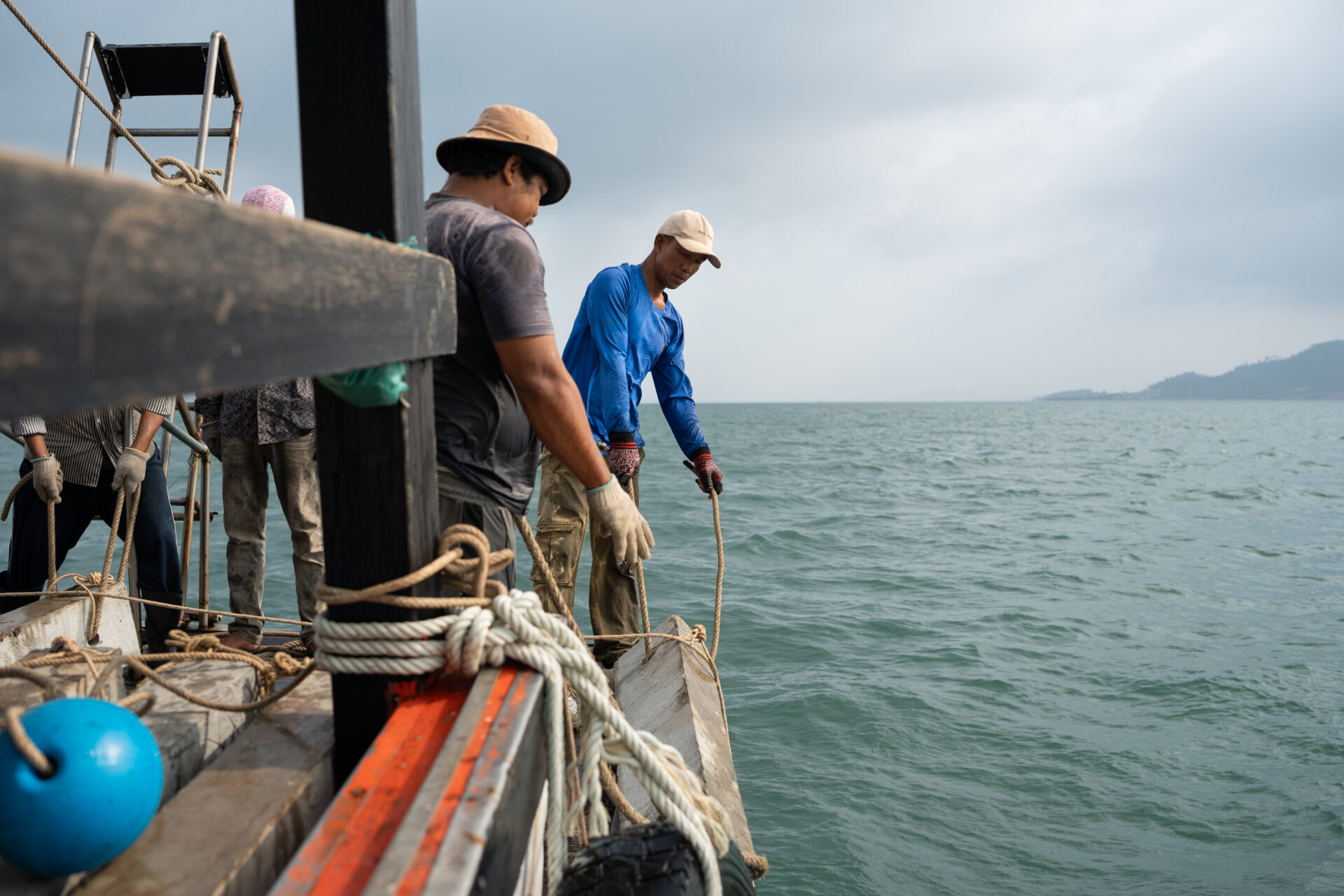
Local fishing communities have been involved at every stage of the project to date, from site selection and block construction through to the deployment and ongoing monitoring of the FPS. This approach is designed to give coastal communities a direct stake in protecting the ecosystems their livelihoods depend on, building the kind of long-term stewardship that conservation projects imposed from above rarely achieve.
“The FPS are vital for protecting the marine ecosystem,” said Vichet Kong, a deployment diver. “I am so proud to be a part of this project, and I believe the other fishermen are just as happy about it.”
Fellow deployment diver, Phang Maly, added: “I will do my best to complete the project on time. This FPS project is truly a miracle for bringing back rare species like dugongs, seahorses, and sea turtles. It is also improving the livelihoods of fishing families along the coast. I hope the younger generation learns to value and understand the importance of this work.”
MCC’s work in this region predates the SCMF Project by several years. The organisation began deploying FPS structures in 2017, and in 2018 was awarded the National Geographic Society Marine Protection Prize, becoming one of only three winners from more than 5,720 projects worldwide. The Kep Archipelago, where MCC is based on Koh Ach Seh, was designated a Mission Blue Hope Spot in 2019, the first – and to date only – such designation in Cambodia, in recognition of both the ecological significance of the area and MCC’s long-term conservation work there.
For Rachana Thap, MCC’s Executive Director, the 25% milestone is not simply a number. It is a record of what the project has cost, and what it has meant, to the people who have built it.
“The 25% goal represents more than a conservation milestone for Marine Conservation Cambodia – it reflects the collective effort, integrity, and sacrifice of local fishers, community fisheries committees, conservation teams, and partners working together to protect Cambodia’s ocean,” said Rachana Thap, MCC’s Executive Director.
“This work was built through storms, rough seas, long patrol nights, and difficult conditions. Over the years, local communities and the MCC team have become united through a shared purpose: protecting the ecosystems that sustain both marine life and coastal livelihoods.”
The project now has some 3,750 waiting to be deployed.


"*" indicates required fields
Printed editions
Current issue
Back issues

Enjoy so much more from Oceanographic Magazine by becoming a subscriber.
A range of subscription options are available.
