New species of deadly box jellyfish discovered in Singapore waters
A new Chironex box jellyfish species has been discovered off Singapore, with a key anatomical difference confirming its identity - alongside a surprising range expansion of a Thai sea wasp into Singaporean waters.
Almost invisible, extraordinarily venomous, and almost entirely unknown… and now, scientists have confirmed that they exist in a greater variety of species than we first realised. Yes, this is the box jellyfish, And yes, an entirely new species has just been discovered.
The discovery was made by researchers at Tohoku University and the National University of Singapore who identified the new species of box jellyfish in the coastal waters off Sentosa Island, Singapore.
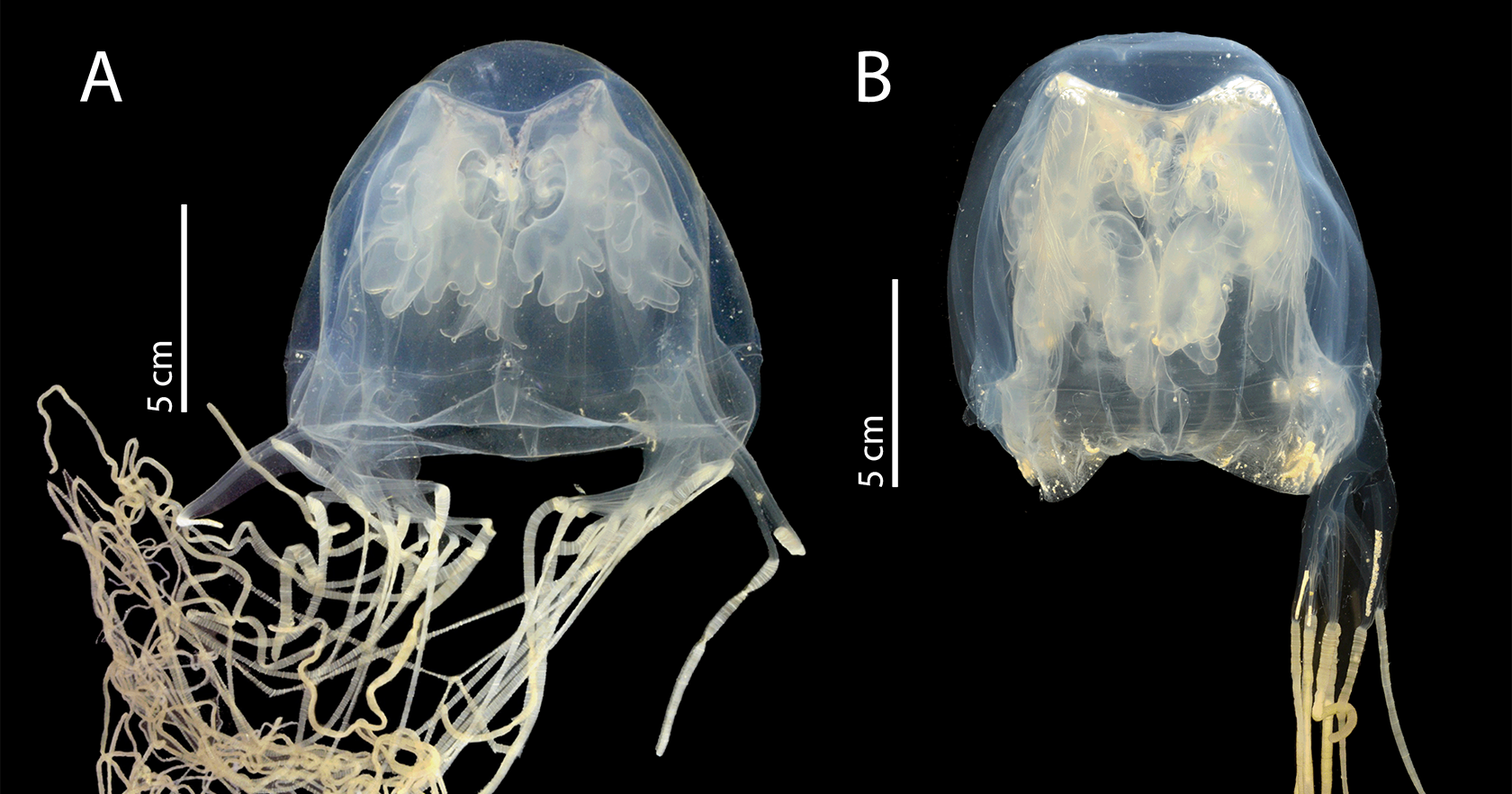
It has been named Chironex blakangmati after the island’s historical Malay name – Pulau Blakang Mati, meaning “Island of Death Behind” – and its discovery adds a fourth member to the Chironex genus, a group of jellyfish whose stings can kill a human being within minutes.
The find was not immediately obvious. To the untrained eye, C. blakangmati bears a striking resemblance to Chironex yamaguchii, a species first documented in Okinawan waters. For years, the two were assumed to be one and the same.
“C. blakangmati looks remarkably like Chironex yamaguchii – a jellyfish species I first discovered in Okinawa while doing my master’s degree there,” says lead researcher Cheryl Ames of Tohoku University. “But we realised they were completely distinct. I actually went back to dust off an old sample of C. yamaguchii I still had in storage in Okinawa to help with the comparisons.”
Genetic analysis resolved the case of mistaken identity, and a detailed morphological examination sealed it. The key distinguishing feature lies in the jellyfish’s perradial lappets – a structural element found at the base of the bell that reinforces the muscular flap it uses to actively propel itself through the water.
In all three previously known species, pointed canals extend from the tips of these lappets. In C. blakangmati, those canals are absent entirely.

In other news



The same expedition brought a second surprise. Samples of Chironex indrasaksajiae, a species typically associated with Thai waters, were recorded in Singapore for the first time – a range expansion that raises fresh questions about the distribution of these animals across Southeast Asian seas.
“We were surprised to find C. indrasaksajiae so far away from Thailand,” Ames notes. “Recording range expansions like these is really important, as we currently know so little about the biodiversity and spatial distribution of box jellyfish.”
Unlike most jellyfish, which drift at the mercy of ocean currents, Chironex are active hunters – equipped with complex eyes and the muscular propulsion to pursue prey with intent. That combination of mobility, near-invisibility, and lethal venom makes understanding their ecology not merely a matter of scientific curiosity, but of genuine public safety.
The findings, published in the Raffles Bulletin of Zoology, offer what the researchers describe as a new framework for species identification across the Chironex genus. The study was supported by WPI-AIMEC and the Sasakawa Peace Foundation’s Ocean Shot Project.


"*" indicates required fields
Printed editions
Current issue
Back issues



Enjoy so much more from Oceanographic Magazine by becoming a subscriber.
A range of subscription options are available.
