Deep-sea expedition reveals new life and old litter 4,000 metres down
Despite being delighted by the discovery of roughly 40 new species, researchers were troubled by what else they found nearly 4,000 metres down: plastic bags, fishing gear and an old boot, scattered across the floor of the Mar Del Plata Submarine Canyon.
Nearly 4,000 metres below the surface, an international team of marine biologists documented roughly 40 species new to science, in their own words, “one of the most extraordinary experiences” they could have had in their career.
Yet off the south coast of Argentina, in the depths of the Mar Del Plata Submarine Canyon, researchers also found plastic pollution. Their cameras captured stills of fishing gear, plastic bags, food wrappers – even an old boot.
The expedition, which took place in the summer of 2025, marked the first time scientists had been able to take images of the seafloor in this area.
“Unveiling a species previously unknown to science in the endless darkness of the deep sea may be one of the most extraordinary experiences a marine biologist can have,” the authors said.
That discovery, however, came with a troubling footnote. Across 10 of the 17 dives with a remotely operated submersible, researchers saw 29 identifiably manmade objects. They observed animals like starfish and corals attached to the debris, partially subsumed by plastic packaging and fishing ropes.
This is not the first time that plastic waste has been found so far below the surface; research from CSIRO, Australia’s national science agency, and the University of Toronto in Canada estimates that up to 11 million tonnes of plastic pollution is sitting on the ocean floor. Roughly 54% of this resides at depths of 200m to 11,000m. And, just a few months before the expedition in the Mar Del Plata Submarine Canyon, a plastic bag was found in the Mariana Trench, the planet’s deepest fissure.

In other news
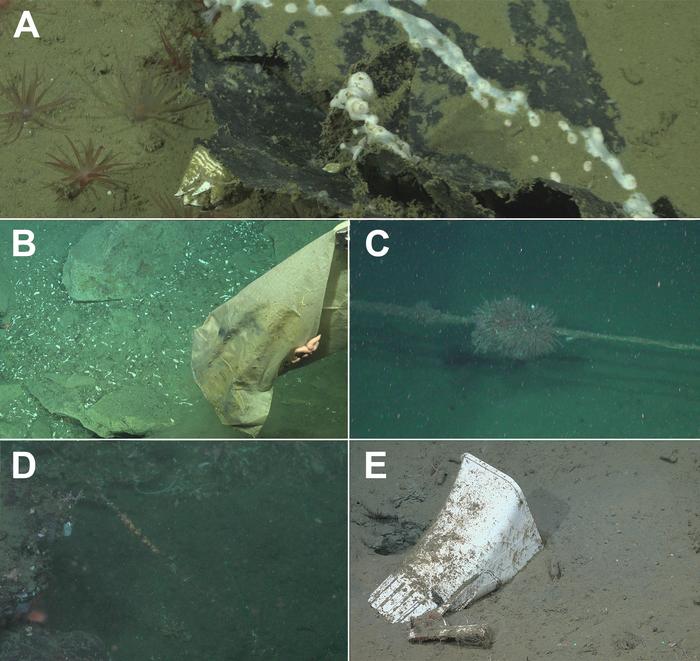
Plastic often gets funnelled into tunnels, like the Mar Del Plata Submarine Canyon, where it accumulates into plastic hotspots.
Plastic production has sharply increased over the last 70 years. In 1950, the world produced just two million tonnes. It now produces over 450 million tonnes.
Organisms on the sea floor generally rely on surface debris – like dead and decaying matter, excretions, and remains of phytoplankton, and large sunken organic matter, like dead whale or fallen tree – for sustenance. However, the growing body of plastic waste has increasingly joined the organic debris making its way to the seafloor. A 2019 Royal Society Open Science study looking into the impact of microplastics on deep-sea amphipods (small shrimp-like crustaceans) found that up to 100% of these creatures at the very bottom of the Mariana Trench have plastic fibres clogging their digestive tracts.
Scientists observed deep-sea life living among the plastics, but cautioned against assuming these objects are suitable habitats; we still know very little about the ecological consequences of this plastic pollution.


"*" indicates required fields
Printed editions
Current issue
Back issues
Enjoy so much more from Oceanographic Magazine by becoming a subscriber.
A range of subscription options are available.
