Europe's hidden tuna empire exposed in 'reflagged vessel' report
A landmark investigation finds that European companies secretly control the majority of the Indian Ocean's industrial tuna fleet, exploiting coastal state quotas, obscuring true ownership, and undermining the sustainability certifications consumers rely on.
European companies are exerting far greater control over industrial tuna fishing in the Indian Ocean than official records suggest, a new report has indicated. It’s a finding that raises serious questions about transparency, sustainability, and the future of one of the world’s most heavily exploited fisheries.
On paper, the Indian Ocean’s tuna fleet looks like a diverse collection of locally owned vessels operating under the flags of coastal states across the region. In reality, however – and according to the new report from Blue Marine Foundation and global investigations firm Kroll – the picture is very different. Because in fact, the fleet is overwhelmingly controlled by a small number of European companies, operating through a complex web of ownership structures.
The report posits that such complexity is designed purely to obscure who ultimately benefits from the catch.
Europe’s Hidden Tuna Empire: Uncovering the true ownership of the Indian Ocean purse seine fleet, finds that EU companies are the beneficial owners of more than 50 purse seine and supply vessels operating across the Indian Ocean, despite many appearing on paper as locally owned.
While more than 20 companies are listed as vessel owners across the fleet, investigators found that around 90% of those vessels are ultimately controlled by just seven European entities, namely Albacora Group, ATUNSA, Inpesca Group of Companies, Parlevliet & Van Der Plas BV, Pesquería Vasco-Montañesa S.A. (PEVASA), SAPMER S.A., and Pesqueras Echebastar S.A.
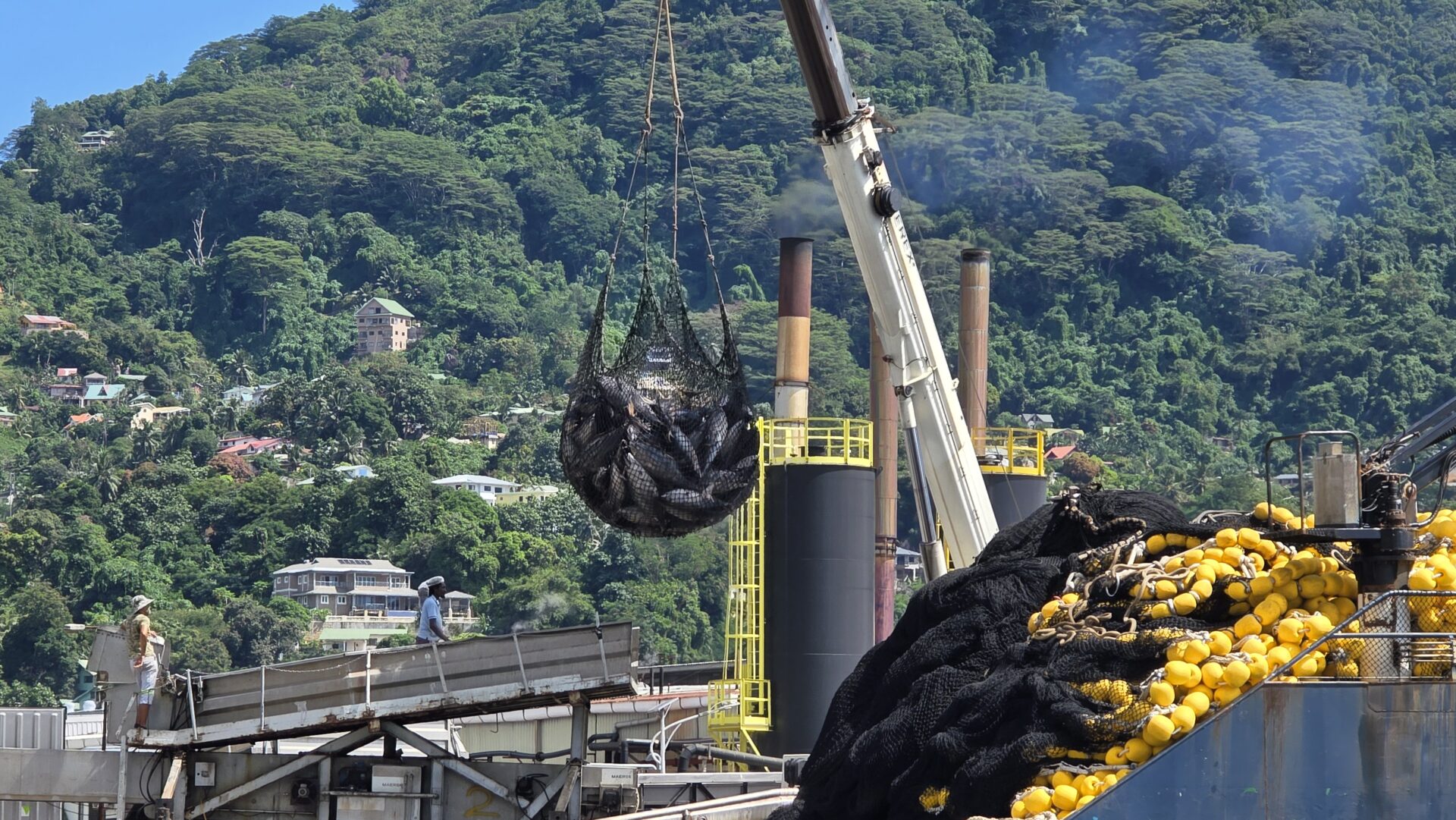
The scale of the catch attributable to this fleet is considerable. EU-owned vessels have accounted for around a third of all tropical tuna taken from the Indian Ocean over the past decade, averaging more than 355,000 tonnes per year.
The investigation argues that the mechanism through which European operators have achieved this level of control is both deliberate and consequential. Vessels are frequently flagged to Indian Ocean coastal states – among them Seychelles, Mauritius, Tanzania, Oman and Kenya – allowing their European owners to access local quotas allocated through the Indian Ocean Tuna Commission (IOTC), the body responsible for managing tuna stocks across the region.
The effect is to make a largely European industrial operation appear, at the level of official records, as a series of locally owned and operated fisheries.
“At first glance it looks like Europe’s industrial tuna fleets have been reducing in the Indian Ocean,” said Benedict Hamilton from Kroll. “In fact, if you unpick the complicated web of ownership it becomes clear that ships that appear to be locally owned in coastal states are in fact ultimately owned by a small number of companies in Europe. Europe’s opportunity to help stop overfishing is greater than first appears.”

In other news


The investigation draws on company records, financial filings and maritime databases including Lloyd’s List Intelligence to map the ownership structures behind the fleet. Its conclusions present a direct challenge to the picture presented by official IOTC data – and to the assumptions underpinning both fisheries management and consumer-facing sustainability certification.
“The true size of the European tuna purse seine fleet in the Indian Ocean is twice what it appears on paper,” said Jess Rattle, Head of Investigations at Blue Marine Foundation.
“Many of these EU-owned vessels fly the flags of developing coastal states like Kenya, Seychelles and Mauritius, exploiting their quota using harmful drifting fish aggregating devices, all while depriving local fishers and disguising the true ownership of the fleet. To add insult to injury, the vast majority of these vessels are MSC certified, giving consumers a false sense of security when purchasing tinned tuna in the UK and EU.”
At a moment when consumer demand for certified sustainable seafood is growing, the Marine Stewardship Council (MSC) certification carried by the majority of these vessels is widely used by retailers and consumers as a benchmark of responsible fishing. This report, however, raises fundamental questions about the integrity of the certification process itself.
Tensions within the IOTC itself over tuna quotas are growing. As too are other factors, such as the use of drifting fish aggregating devices, and the balance of access between industrial fleets and the coastal states whose quota they are exploiting.
Yellowfin and bigeye tuna have both faced periods of overfishing in recent years. Coastal communities across the Indian Ocean remain heavily dependent on tuna stocks for food security and livelihoods – dependencies that are structurally more exposed to long-term stock decline than those of the European companies whose vessels are doing much of the catching.
Researchers argue that while EU fleets are able to shift operations between oceans in response to market conditions, coastal states are far more exposed to any long-term decline in tuna populations.


"*" indicates required fields
Printed editions
Current issue
Back issues


Enjoy so much more from Oceanographic Magazine by becoming a subscriber.
A range of subscription options are available.
