Icelandic whaling vessel violates animal welfare laws in renewed hunt
Data from Icelandic veterinary authorities has revealed a fin whale was shot four times with exploding harpoons, sparking urgent calls for regulators to seize the ship and for the government to outlaw the practice ahead of Iceland's EU referendum.
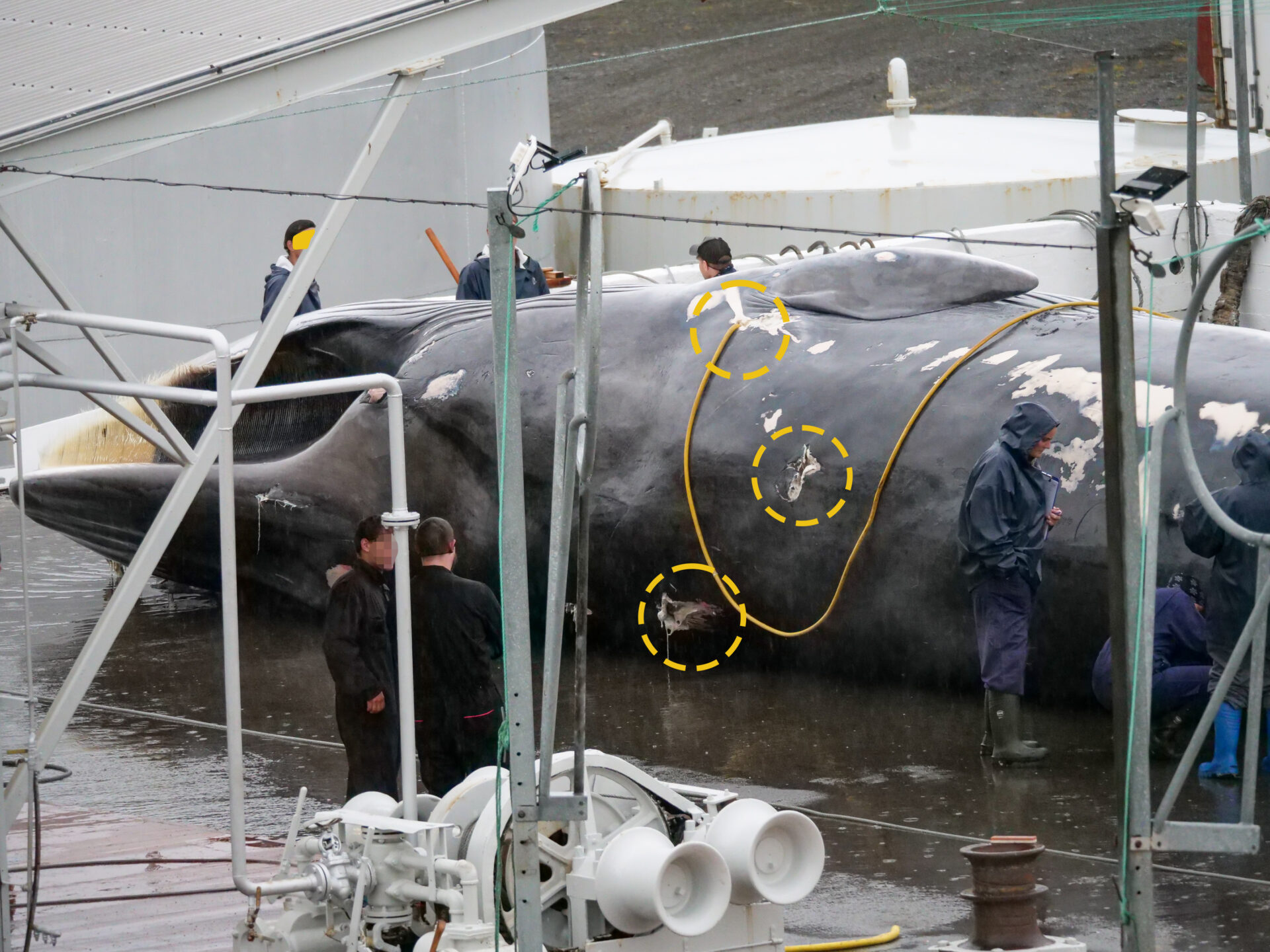
The third whale to have been killed in Iceland’s renewed hunting season was shot with exploding harpoons four times, and took more than 30 minutes to die, an assessment from the Icelandic veterinary authority, MAST, has confirmed today. It’s an event in stark violation of both the country’s animal welfare laws and whale regulations.
Campaigners are calling on MAST to exercise its power to impound – legally seize – the whaling vessel responsible.
The MAST report shows that the male – and otherwise healthy – fin whale was first shot at 17:06. It was then shot at 17:19, again at 17:26, and finally 17:37 until – with its jaw slack, flippers close to its side, and its tail fluke finally still and motionless – it was declared dead.
The individual was recorded to have taken around 31 minutes to die – a stark violation of Icelandic animal welfare and whaling regulations.
In 2023 an independent report released by the Icelandic Food and Veterinary Authority found that some whales killed in Icelandic hunts took up to two hours to die and that 41% of whales suffered immensely before dying, taking an average of 11.5 minutes to die.
This year a quota has been set by the Marine Research Institute, which allows Iceland’s whaling ships to kill up to 318 fin and minke whales. So far eleven whales have been killed, including a pregnant mother and her unborn calf.
Luke McMillan, from Head of Hunting and Captivity at Whale and Dolphin Conservation, said: “MAST’s own monitoring record is damning. This whale, taken by Hvalur 8 in June 2026, was struck, went under, appeared dead, then surfaced alive again six minutes later.”
In 2023, the rules were tightened after their review found the hunt could not meet Iceland’s Animal Welfare Act. Restrictions were brought in which required whaling to take place in the daylight only, and that an immediate second shot was fired if the had first failed.
McMillan added: “It made no difference. On this vessel, thirteen minutes passed between the first harpoon and the second, and the whale took four explosive harpoons and 31 minutes to die.”
MAST has previously suspended this exact vessel, back in 2023, docking it for eight days and landing the company with a fine for failing to fire an immediate second shot.
“Its own record shows that same boat leaving thirteen minutes between the first and second harpoon. So the question isn’t whether MAST has the power to act. It has used it before, on this vessel, for this. The question is why it hasn’t now,” McMillan added.

In other news


The power however, ultimately lies at the feet of the Minister of Industries, Hanna Katrín Friðriksson.
Friðriksson has previously recognised that whaling is not in the public interest, and has promised a bill to run in Autumn 2026 introducing legislation to stop whaling. For now though, the whaling license in Iceland is alive, and the killing has restarted. Hope has surfaced among local campaigners that through the documentation of killings this summer season – and raising awareness of the violations taking place at sea – those calls to implement the whaling ban across Iceland will be reinforced.
Arne Feuerhahn, founder of the local marine conservation non-profit, Hard to Port was on the scene to document the moment the third whale was brought in by whalers.
“You could tell instantly, as soon as this individual was brought onto the port, that something was different. Something was not right. There was a change in atmosphere among the fishers and the whale was displaying a distress that I had not seen before,” he told Oceanographic. “On my my initial estimations, I counted three harpoon wounds. It wasn’t until the report came back from the veterinary authorities I realised there was, in fact, four wounds.
“You just imagine, this animal in such distress and pain for 31 minutes, trying to dive to evade its fate. Thirty one minutes until it eventually found relief in death. It is beyond heartbreaking.”
Arne is one among a strong community of campaigner and locals standing in stark opposition of the whale hunt.
“It is my hope that by showcasing the reality of what is happening out at sea to these whales – in their own home – we can reinforce the calls here in Iceland to implement this ban come the Autumn,” he added. “There is nowhere left to hide. No one in Iceland wants this. We must bring this needless and senseless suffering to an end. The minister knows what she needs to do. It is my hope that she will do it.”
For the time being, regulators in Iceland have the power to document the cruelty and temporarily impound a boat, but it cannot stop the hunt in its entirety. Iceland, Japan and Norway are the only countries to continue commercial whaling despite the global moratorium. Fin whales are classified by the International Union for Conservation of Nature as globally vulnerable to extinction despite decades of recovery since commercial whaling was outlawed across the globe.
This summer’s whaling season also comes with an economic consideration, potentially impacting Iceland’s whale watching tourism industry. Rannveig Grétarsdóttir, ceo and owner of the Elding whale watching enterprise still believes Iceland has a unique opportunity to be recognised for protecting and celebrating marine wildlife rather than for exploiting it.
“Having worked in whale watching for many years, I have seen firsthand how much these animals mean to both Icelanders and visitors from around the world,” she told Oceanographic. “Every whale has a far greater value alive, contributing to healthy ecosystems and supporting sustainable tourism that benefits coastal communities year after year.”
In two months time, Iceland will host a referendum on whether to join the European Union, a body that has long-held an anti-whaling stance.
“I believe many people in Iceland feel that continued whaling does not reflect the country’s image or the direction we should be taking,” said Rannveig.
Of the report into animal welfare violations, Wendy Higgins, from Humane world for Animals, said: “This is not the first time that such cruelty has been exposed in Iceland’s whale hunt but it is a damning indictment of this senseless killing and yet more evidence to support the urgent need for the Minister to make good on her pledge to bring forward a bill to ban whaling once and for all.”


"*" indicates required fields
Printed editions
Current issue
Back issues
Enjoy so much more from Oceanographic Magazine by becoming a subscriber.
A range of subscription options are available.
