Microplastics are compromising the Mediterranean's critical corals
A first-of-its-kind study finds that prolonged microplastic exposure significantly reduces respiration rates in Mediterranean gorgonians — raising concerns about the long-term resilience of the seabed ecosystems they support.
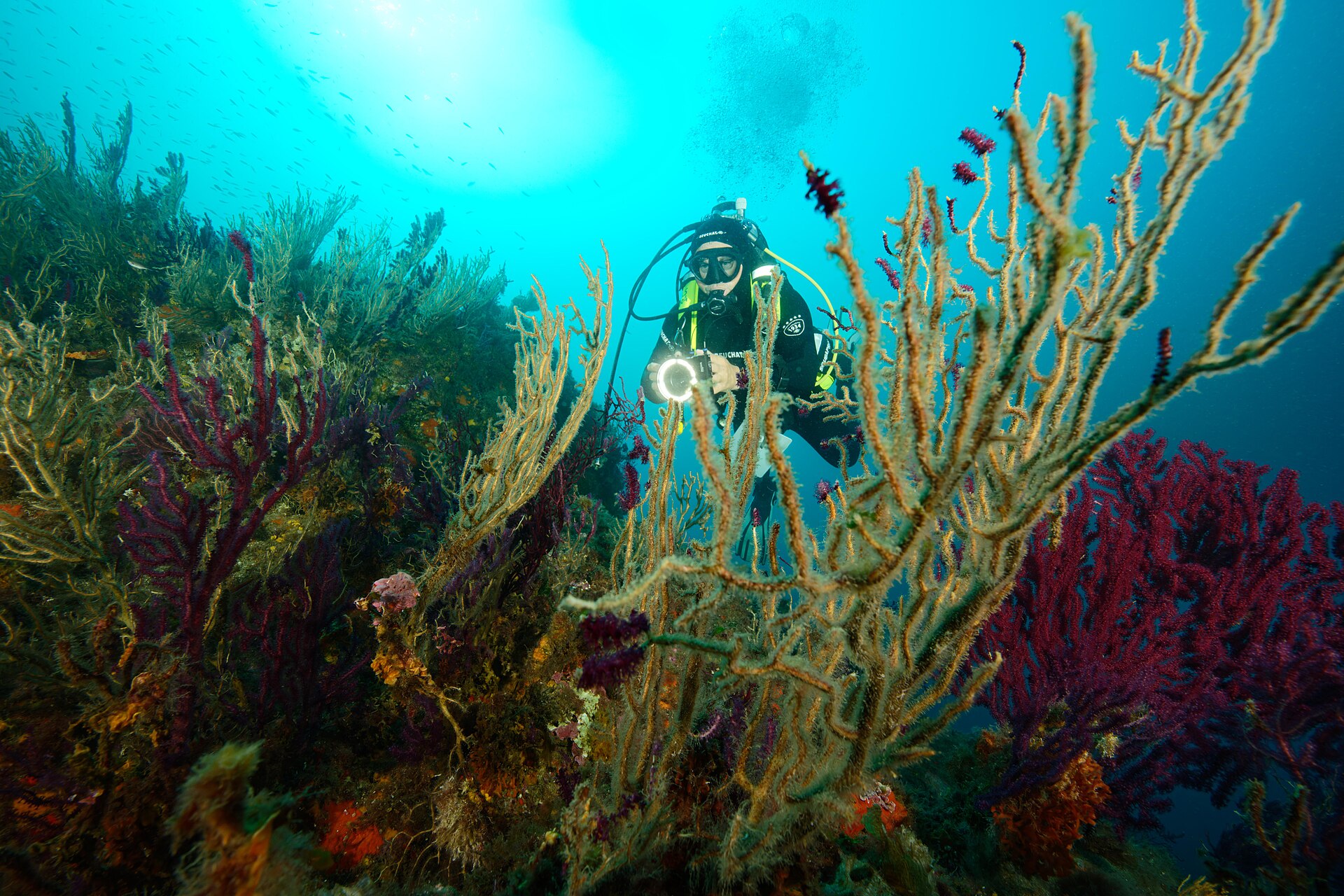
They are among the architects of the Mediterranean seafloor; colonial organisms that create the complex habitat that fish and invertebrates depend upon. Gorgonians – sometimes called sea fans or sea whips – are essentially a foundational species. Which is why a new study published in Marine Pollution Bulletin carries implications that extend well beyond those it set out to examine.
Led by researchers at the University of Barcelona and the Institute of Aquatic Ecology at the University of Girona, this new study is the first to analyse the effects of prolonged microplastic exposure on gorgonians – specifically the white gorgonian, Eunicella singularis, and the violescent sea-whip, Paramuricea clavata.
The findings are both significant and unsettling: microplastics are altering key physiological processes in these organisms, and doing so in ways that leave no visible trace.
To conduct the study, researchers Odei Garcia-Garin and Nuria Viladrich exposed colonies of both species for three months to a mixture of the most common plastic particles found in the ocean – polyethylene terephthalate (PET), polystyrene (PS), and polypropylene (PP) – at concentrations designed to simulate real conditions in the Mediterranean. They then monitored a suite of physiological indicators: respiration, prey-capture ability, organic matter content, microplastic ingestion, and the condition of biological tissues.
Strikingly, the pair found no visible tissue damage, or any signs of histological change. In fact, under the microscope, the colonies looked unaffected. However, it was at a metabolic level that something was happening; something the naked eye couldn’t detect.
“Respiration rates fell significantly in both species of gorgonian, which suggests a reduction in metabolic activity. This physiological response could indicate an adaptation to stress or energy-saving strategies,” said Nuria Viladrich, IRBio & Faculty of Biology, University of Barcelona.

In other news


According to Viladrich’s assessment, a reduction in respiration is not the same as visible damage. But it is a signal. The gorgonians were responding to the presence of microplastics in their environment by drawing down their metabolic rate, potentially as a stress response or as a means of conserving energy under conditions of chronic, low-level pollution.
The colonies also ingested microplastics, with PET particles proving the most prevalent. Here the findings offer a glimmer of reassurance – but not entirely.
Feeding behaviour and organic matter content remained stable across both species, suggesting the organisms were able to compensate energetically by maintaining their capacity to capture prey. Microscopic analysis revealed no structural damage to tissues, indicating that gorgonians may be reasonably effective at eliminating ingested particles before they accumulate.
However, it is the metabolic cost of doing so over time that concerns the researchers. Alongside the wider significance of the research.
Gorgonians are structural engineers of the seabed. The habitats they form on rocky Mediterranean substrates are among the most biodiverse in the region, providing shelter, feeding grounds, and nursery habitat for a wide range of fish and invertebrates. When a habitat-forming species begins to show signs of metabolic stress, the implications cascade outward through the entire community it supports.
The study was carried out in controlled laboratory conditions designed to mirror the concentrations of microplastics already present in the Mediterranean.
“Understanding how habitat-forming species respond to plastic pollution will be essential for assessing the ecological impact of microplastics on a global scale,” said Odei Garcia-Garin, IRBio-UB & IEA-UdG.
While the colonies studied showed no lethal effects and their feeding appeared robust, the metabolic changes observed over three months point towards something more insidious – a slow draining of energetic reserves that may, over longer timescales and under additional pressures, begin to compromise the ability of these organisms to recover from disturbance, reproduce successfully, or withstand the compounding stresses of ocean warming and habitat degradation.
“Further studies will be needed to assess whether these energy costs could compromise the resilience and ecological role of Mediterranean gorgonians in future climate scenarios,” the authors conclude.


"*" indicates required fields
Printed editions
Current issue
Back issues


Enjoy so much more from Oceanographic Magazine by becoming a subscriber.
A range of subscription options are available.
