New diet for bluefin tuna after Atlantic herring collapse
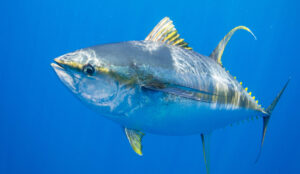
Atlantic bluefin tuna are dialling into a new diet within the Gulf of Maine, researchers have observed, shifting away from Atlantic herring - whose numbers have hit historic lows in recent years - and towards an alternative, fatty pelagic species: menhaden.

Atlantic bluefin tuna are dialling into a new diet within the Gulf of Maine, researchers have observed, shifting away from Atlantic herring – whose numbers have hit historic lows in recent years – and towards an alternative, fatty pelagic species: menhaden.
The findings marked as an important discovery and indication of the shifting food web, driven by anthropogenic factors including overfishing of herring and climate change. Researchers behind the study note that menhaden – a species already targeted for use in fish oils – now faces additional pressures as a vital food source for an important predator.
The findings have been documented by scientists at the University of Maine’s Pelagic Fisheries Lab and published recently in the journal Marine Ecology Progress Series. It illustrates not only the shift in the tuna’s diet but also describes the role of foraging in the tuna’s lifecycle.
Sammi Nadeau, the lab manager at University of Maine’s Pelagic Fisheries Lab and lead author on the study, said: “You can imagine that those migrations from across the oceans and things like reproduction are extremely energetically demanding. So being able to get a really good meal, fill back up, and get ready to go back across the ocean is important to fulfil their life history.”
As recorded in studies dating back to the 1980s, there was a time when the diet of choice for the Atlantic bluefin tuna in the Gulf of Maine was the Atlantic herring. In recent years, however, the Atlantic herring population within the region has hit historic lows. Recognising the role Atlantic herring have played in tuna diets in the past, researchers were prompted to ask how tuna were filling this new gap today.
Nadeau and the Pelagic Fisheries Lab – led by associate professor Walt Golet in the University of Maine School of Marine Sciences, teamed up with partners in fishing tournaments and commercial fishing operations in 2018 and 2019 to secure tuna stomachs. These were then filtered for their contents with the aim of identifying everything inside to determine exactly what species were present.
Researchers observed a large shift in diet from herring towards menhaden, alongside Northern shortfin squid. While researchers suspected they would find a decline in the presence of herring, they were left surprised by how large a role menhaden now played.
In other news





The issue for menhaden – and by that reason, tuna too – is it’s already a species targeted for its commercial role in fish oils. Now, as a food source for this important predator species – scientists fear that local populations will face increased pressures. Diet and foraging ecology research ensures marine resource managers have the information necessary to create commercial limits and reduce burdens on fish populations when needed.
Additionally, this information helps researchers understand Atlantic bluefin tuna as a species that migrates thousands of miles each year, visiting a diverse range of environments.
The study also quantified how energetics – or the energy that food sources can provide to the tuna – were affected by these dietary shifts.
Once the stomach contents were identified, it was possible to find fish from those species and calculate just how energetically rich each prey item was. To work this out, researchers used a tool called a ‘bomb calorimetre’ which tests a sample by burning it in a sealed container surrounded by water and measuring the change in temperature to get a measure of the energy released by the reaction.
By and large, researchers believe that menhaden and Atlantic herring share a similar energetic profile, which in addition to the other prey, enables the species to migrate and reproduce.
Historically, Atlantic bluefin tuna arrive in the Gulf of Maine during late spring and spend the summer eating Atlantic herring, storing up energy before travelling to their spawning grounds in the Gulf of Mexico, Slope Sea, and Mediterranean. With the collapse of the herring population, tuna have now had to turn to these alternative food sources.
“Through energetic analysis, we found that the menhaden are relatively similar in terms of their caloric profile, which is really good for the tuna because it means they are still going to be able to get that energetic input,” said Nadeau.
Maine’s coastal communities have been hooked on the Atlantic bluefin tuna since at least the late 1880s. It was in the 1930s the species became a prized target in fishing tournaments. In 2024, the National Oceanic and Atmospheric Administration reported that commercial and recreational landings of tuna exceeded 3.5 million pounds, fuelling a range of economic activities from food markets to boat building and gear sales.


"*" indicates required fields
Printed editions
Current issue
Back issues


Enjoy so much more from Oceanographic Magazine by becoming a subscriber.
A range of subscription options are available.
