Could a crack-down on China's shark conservation save a species?
A formal US petition demands accountability for China's high seas shark fishing, citing tens of thousands of discarded sharks annually and Hong Kong's role as the world's largest - and largely unregulated - shark fin trading hub.
Stronger shark conservation policies across China could – in effect – save the species from extinction, is the argument being levelled at the United States via a petition asking the US to better hold China accountable for failing to meet basic conservation standards.
New data, released by the Center for Biological Diversity, has revealed the scale of a crisis that has already eliminated more than two-thirds of the world’s oceanic sharks.
More than 80 million sharks are caught every year, driving a population decline by more than 70% since 1970. More than a third of all shark and ray species are now threatened with extinction. At the centre of that crisis sits the world’s largest high seas fishing fleet – operated by China, a nation that has yet to adopt shark conservation measures comparable to those required under United States law.
The Center for Biological Diversity has now filed a formal petition with the National Marine Fisheries Service (NMFS), asking the agency to identify China as a nation whose fishing practices fall short of US shark conservation standards – a designation that could ultimately trigger restrictions on Chinese seafood imports into the United States.
“China catches so many sharks that stronger shark conservation policies in the country could actually save these incredible creatures from extinction. We’re asking the United States to use every tool at its disposal to make that happen,” said Alex Olivera, senior scientist at the Center for Biological Diversity.
“Sharks have survived for hundreds of millions of years, and it would be a tragedy to lose them in our lifetime. We’ve already lost more than two-thirds of the world’s oceanic sharks and rays in just the past five decades. These animals absolutely can’t withstand this level of overfishing.”

In other news




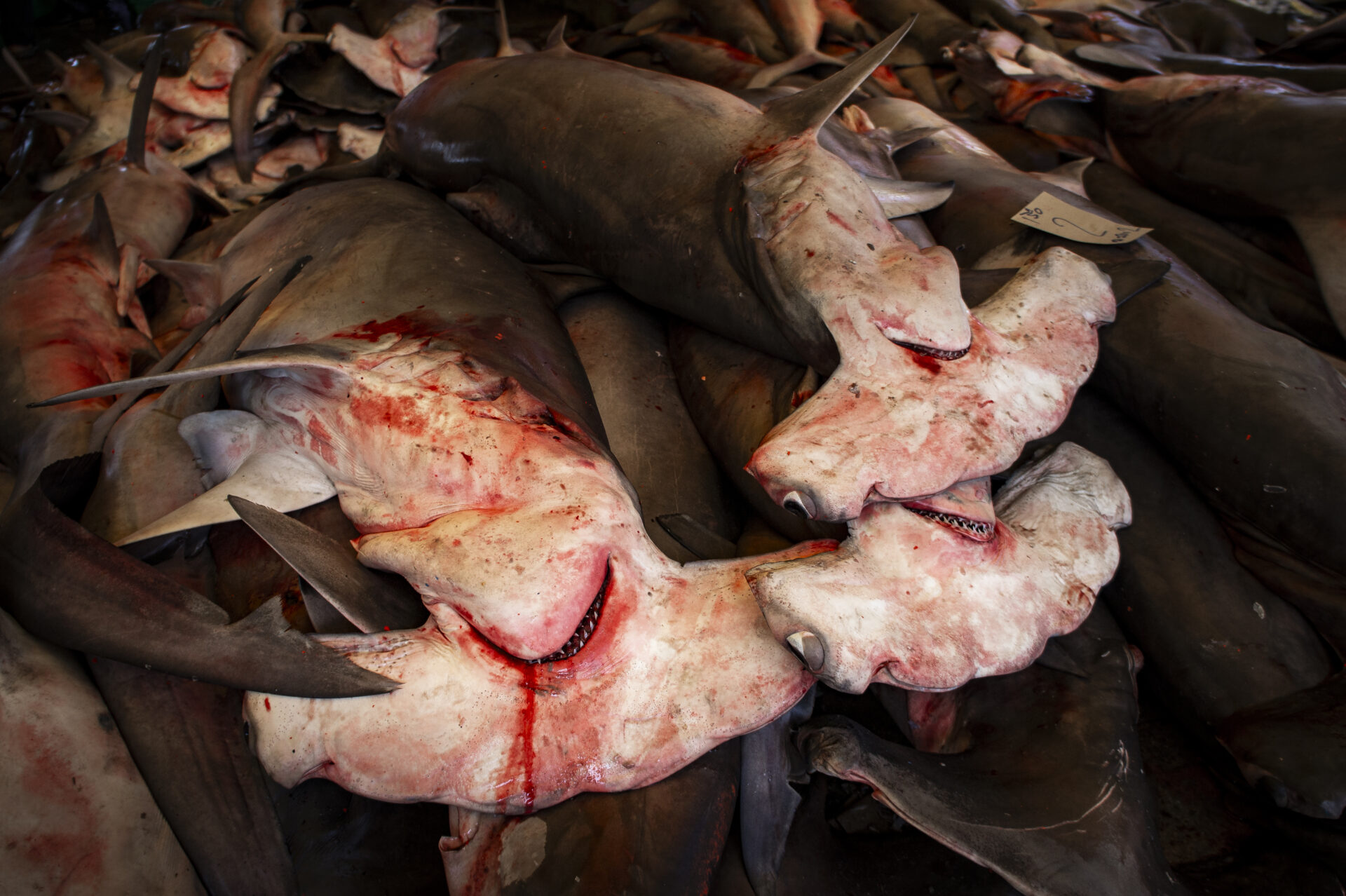
The petition invokes the US Moratorium Protection Act, which requires NMFS to identify nations whose high seas fishing fleets catch sharks without adopting conservation measures comparable to American law. The United States prohibits shark finning, requires that sharks be landed with their fins naturally attached, and bans the possession, transport and sale of shark fins and fin products, with narrow exceptions.
While China has introduced a domestic ban on shark finning, it has not adopted equivalent protections across all of its fisheries – leaving a significant gap between its current framework and the standard US law demands.
The scale of China’s shark catch makes that gap consequential at a global level. Chinese-flagged vessels operate across multiple oceans, targeting tuna but routinely catching sharks as bycatch – including critically endangered oceanic whitetip sharks and endangered shortfin mako sharks. The official data cited in the petition, submitted by China itself to international fisheries bodies, documents the extent of the problem.
In the western and central Pacific alone, Chinese vessels discarded more than 10,000 blue sharks and nearly 1,700 shortfin mako sharks in a single year. Discarded sharks, even when their fins remain attached, frequently die from the injuries and stress of capture.
Hong Kong remains the world’s largest shark fin trading hub – and the evidence suggests that a significant proportion of the trade passing through it is operating outside any legal framework. A peer-reviewed study published in 2025 found fins from four internationally regulated species in Hong Kong markets, with 80% of the nations exporting those fins having never reported any such trade to the relevant international bodies.
Hong Kong customs officials made multiple seizures exceeding one metric tonne each in both 2023 and 2024.
Under the Moratorium Protection Act, if NMFS formally identifies China as potentially falling short of the required standards, it must enter into consultations and reach a certification decision within two years. Should the agency conclude that China has not adopted comparable conservation measures, the President of the United States is empowered to direct agencies to restrict imports of Chinese seafood – a significant lever of economic pressure that the Center for Biological Diversity is explicitly asking the US government to be prepared to use.
The petition represents one of the more direct attempts yet to deploy the architecture of US trade law in the service of international shark conservation. Whether NMFS acts on it, and how China responds if it does, may prove a significant test of whether economic consequences can achieve what conservation commitments alone have not.


"*" indicates required fields
Printed editions
Current issue
Back issues
Enjoy so much more from Oceanographic Magazine by becoming a subscriber.
A range of subscription options are available.
