Sliteye shark discovered in Chagos Archipelago a new first
The recent sightings in deepwater seagrass meadows underscore the ecological importance of the Chagos Archipelago and its Marine Protected Area, revealing previously undiscovered biodiversity in its reefs and seagrass beds.

The sliteye shark has been recorded for the first time on the Great Chagos Bank, the world’s largest coral atoll structure, marking a major advance in understanding the geographic range of this near-threatened species.
The recent sightings in deepwater seagrass meadows underscore the ecological importance of the Chagos Archipelago and its Marine Protected Area, revealing previously undiscovered biodiversity in its reefs and seagrass beds.
Another study recently published went to new lengths to showcase how huge marine protected areas, such as that across the Chagos Archipelago are in fact working, protect large species of marine life across almost the entirety of their lifecycle.
Named for its distinctive, slit-like eyes – thought to enhance vision in low-light conditions – the slit-eye shark (Loxodon macrorhinus) is well adapted to deeper, dimly lit environments as well as clear shallow water, and has now been found in the Chagos Archipelago for the first time.
The sightings occurred in previously unstudied seagrass on the southern rim of the Great Chagos Bank. The sharks were captured just 11km apart, at depths of 23 to 29 metres, using Baited Remote Underwater Video (BRUV) systems – underwater survey systems that attract and record marine life without human disturbance.
Given the species’ wide distribution, researchers believe it’s unlikely that it is rare in Chagos.
Charlotte Oulton, study lead and Master’s by Research student in the Marine and Conservation Ecology Lab at Swansea University, said: “Discovering the sliteye shark in the Chagos Archipelago was incredibly exciting. Not only is it a new record for the region, but it also highlights how much we still have to learn about deepwater seagrass ecosystems and their role in supporting marine biodiversity, particularly in remote regions of the Indian Ocean.”
In other news
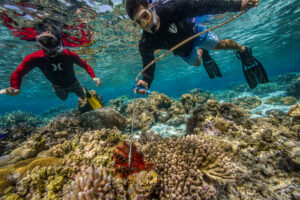


The extensive seagrass meadows on the Great Chagos Bank were actually discovered by accident when researchers were using satellite tracking to study green turtles in the region. The revelatory discovery surprised scientists for not only being found at depths of 25 to 30 metres – far deeper than expected – but for the wide variety of marine life using the seagrass habitat for shelter and food, including over 110 fish species and the sliteye shark.
With sliteye shark populations projected to decline by up to 29% in the next 15 years due to fishing pressures, this discovery raises important questions about species abundance, habitat use, and conservation priorities. It also reinforces the urgent need to explore and protect deepwater habitats.
These latest findings, based on surveys conducted in late 2024, are part of a collaborative project between Swansea University and international partners, funded by the Bertarelli Foundation through the Bertarelli Foundation’s Indian Ocean Marine Science Programme. The research aims to map current seagrass coverage, model habitat suitability to predict the likely extent of seagrass growth, and assess the ecological importance of deepwater seagrass ecosystems across the Archipelago.
A recent study, in which sea turtles, manta rays, and seabirds – species that all travel far and wide to forage, breed, and migrate – has shown that sizeable marine protected areas can be effective in protecting such species through most of their lifecycle. The Chagos Archipelago – used as the example for this paper – currently boasts an MPA totalling 640,000 square-kilometres.
“Very large Marine Protected Areas (VLMPAs) are seen as essential for meeting international goals, such as the target for 30% protection by 2030,” said Dr Alice Trevail from the Environment and Sustainability Institute at the University of Exeter’s Penryn Campus in Cornwall. “Our results provide clear evidence for the value of the Chagos Archipelago VLMPA for protecting a diverse range of large and mobile marine species.”
With the anticipated change in sovereignty, as the Chagos Archipelago becomes a part of Mauritius, the findings from the two studies are increasingly important. While providing compelling evidence for the value of the MPA, they also indicate areas that are priorities for future long-term protection to ensure the viability of this marine megafauna community.


"*" indicates required fields
Printed editions
Current issue
Back issues
Enjoy so much more from Oceanographic Magazine by becoming a subscriber.
A range of subscription options are available.