“They can't be trusted to protect our health”: The human cost of sewage crisis
A new three-part Channel 4 docudrama follows the story of death and destruction caused by years of sewage pollution in British waterways. Campaigners and victims are calling for the government to take action on the issue.
A three-part docudrama, Dirty Business, will air tonight at 9pm on Channel 4 exposing the harrowing impact of sewage pollution.
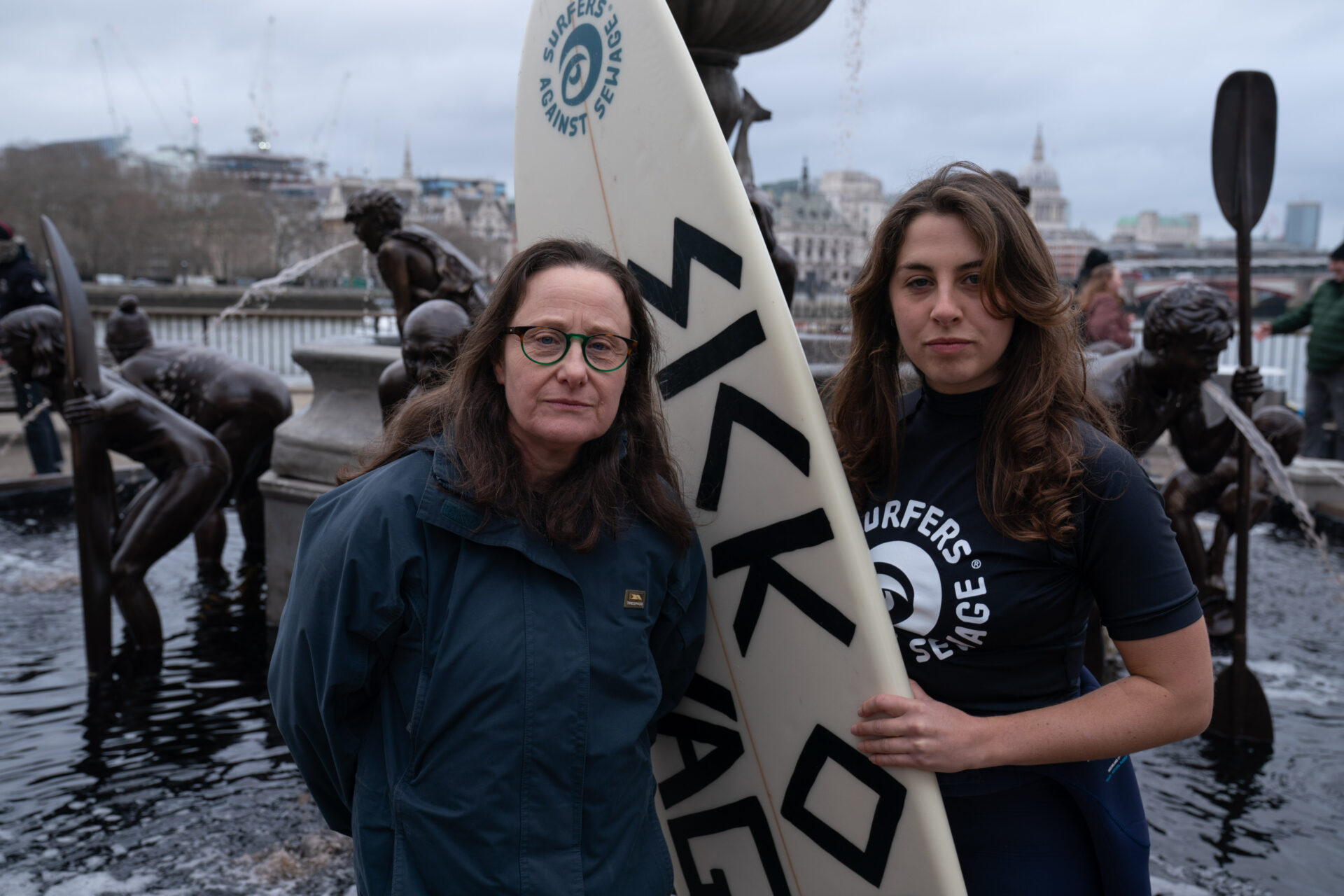
Central to the programme is Julie Maughan, mother of Heather Preen, who died in 1999, aged eight, two weeks after contracting E. coli on a family holiday in Devon. Maughan, along with other victims of the sewage crisis, and grassroots campaign groups like Surfers Against Sewage (SAS) are calling for the government to end the current privatised water industry.
To mark the series launch, Channel 4 installed ‘The Fountain of Filth’ on London’s South Bank, with statues of the men, women and children vomiting brown water.
As Dirty Business airs, the water crisis it depicts is still unfolding. SAS has released new data that reveals over 124,000 hours of sewage poured into England’s bathing waters in 2025. 1,236 people also reported getting sick across England after using the water and nearly three out of four (74%) cases were recorded at bathing waters classified by the Environment Agency as ‘good’ or ‘excellent.’
Among them is seven-year-old Willow Clarke who contracted the parasite cryptosporidium after swimming on a holiday in Cornwall last August and was severely unwell for 12 days, narrowly avoiding hospitalisation.
So far in 2026, SAS data shows that sewage has been dumped into England’s bathing waters for over 46,141 hours.
The government set out in its Vision for Water White Paper this January, but campaigners have said the proposed legislation would entrench the failing privatised system rather than end it.
Surfers against sewage are urging the Government to take control of water companies and restructure them to remove the profit motive and ensure they operate in the interests of people and the environment.
Julie Maughan said: “My daughter Heather was eight years old when dirty water killed her. She was a fun-loving little girl who knew only love, happiness and friendship. That summer we went on holiday as a family of four and came home as a family of three.”
“Water companies tried to deflect blame for Heather’s death and twenty-seven years later they are still pumping sewage into our waterways,” she added, “They cannot be trusted to protect our health.”

In other news



Giles Bristow, Surfers Against Sewage Chief Executive, said: “Dirty Business tells the truth the water industry has spent thirty years trying to bury. A girl is dead. Thousands are still getting sick. And what does this Government offer? More of the same.
Bristow added: “Its hollow reform plan, laughably called ‘once-in-a-generation,’ tinkers with regulation while protecting the ruthless pursuit of profit. That is an insult to everyone who has suffered, and every bill-payer forced to foot the bill for this scandal.”
In the last 34 years since privatisation, the water industry has accumulated a debt pile of £73bn while paying out dividends of £88.4bn.
Dirty Business also features the story of Reuben Santer, a surfer and teacher who contracted an incurable ear disorder, Ménière’s Disease, after surfing in sewage.
Santer said: “Developing a chronic illness after surfing in polluted water has changed my life.”
“How does this happen in a wealthy country in 2026? I’m sick of it. This isn’t bad luck” he added, “it’s the predictable result of monopoly providers prioritising shareholder returns over public health.
“We deserve rivers and seas that don’t make us sick, and a water system built for people and the environment, not profit,” Santer said.
Suzi Finlayson, developed a blood infection after swimming off the coast of Bognor Regis, which led to life-threatening infective endocarditis and required open heart surgery.
Finlayson told us: “I was at risk of dying – I’m lucky to be here thanks to the surgeons at Brighton hospital, but it shouldn’t have got to that.”
“It is a public health crisis, and I think it’s going to get worse and worse, but it can’t go on. We should be able to swim in our sea and use our beach,” she added.


"*" indicates required fields
Printed editions
Current issue
Back issues

Enjoy so much more from Oceanographic Magazine by becoming a subscriber.
A range of subscription options are available.