Three quarters of Indo-Pacific coral reefs could drown as sea levels rise
Rising seas could outpace most Indo-Pacific coral reefs within 35 years, a new study warns, threatening coastal protection for millions.
Most coral reefs across the Indo-Pacific will not be able to grow fast enough to keep up with accelerating sea-level rise, according to a new study, raising the risk that reefs could become submerged and lose their ability to protect coastlines.
Researchers from Nanyang Technological University (NTU) in Singapore found that 76% of the reef sites they surveyed lack the capacity to keep pace with projected sea-level rise under a high greenhouse gas emissions scenario.
The study identified a critical tipping point: once relative sea level rises by more than 5.3mm a year, there is a greater than 90% chance reefs will be unable to maintain their upward growth. On current trends, that threshold is likely to be crossed within 35 years unless emissions are substantially cut.
Coral reefs provide essential coastal protection: a healthy, whole coral reef absorbs 97% of wave energy before it hits land, and a wave passing over a complete reef reduces the actual height of waves by more than 75%, according to a global meta-analysis of reef structures published by researchers in Nature Communications.
This new research on coral drowning was published in Nature Communications and led by Dr Riovie Ramos, a research fellow at NTU’s Earth Observatory of Singapore, and Assistant Professor Kyle Morgan of NTU’s Asian School of the Environment.
Coral reefs have kept pace with rising seas for thousands of years by building themselves upward, as corals and other organisms produce calcium carbonate that forms the reef’s structure. This keeps reefs close to the surface, where corals can access sunlight and break the force of waves before they reach the shore.
But if sea levels rise faster than a reef can build, the reef becomes progressively submerged, in a process scientists call reef drowning. The coral may still be alive, but the reef loses the shallow, complex structure that protects coastlines and shelters marine life.
As reefs become submerged, larger waves are able to pass over them, increasing the risk of coastal erosion and flooding for low-lying islands and tropical coastlines. The loss of complex reef structures could also reduce habitats for fish and other marine life, with knock-on effects for fisheries, tourism and coastal communities that depend on reefs.
“Coral reefs have kept pace with rising seas for thousands of years, but the rate of sea-level rise expected in the coming decades could exceed the limits of most reefs,” said Morgan. “When that happens, reefs will become progressively submerged. They may still contain living corals, but they will no longer function in the same way, potentially allowing greater wave energy to reach the coastline and increasing risks to coastal communities.”

In other news
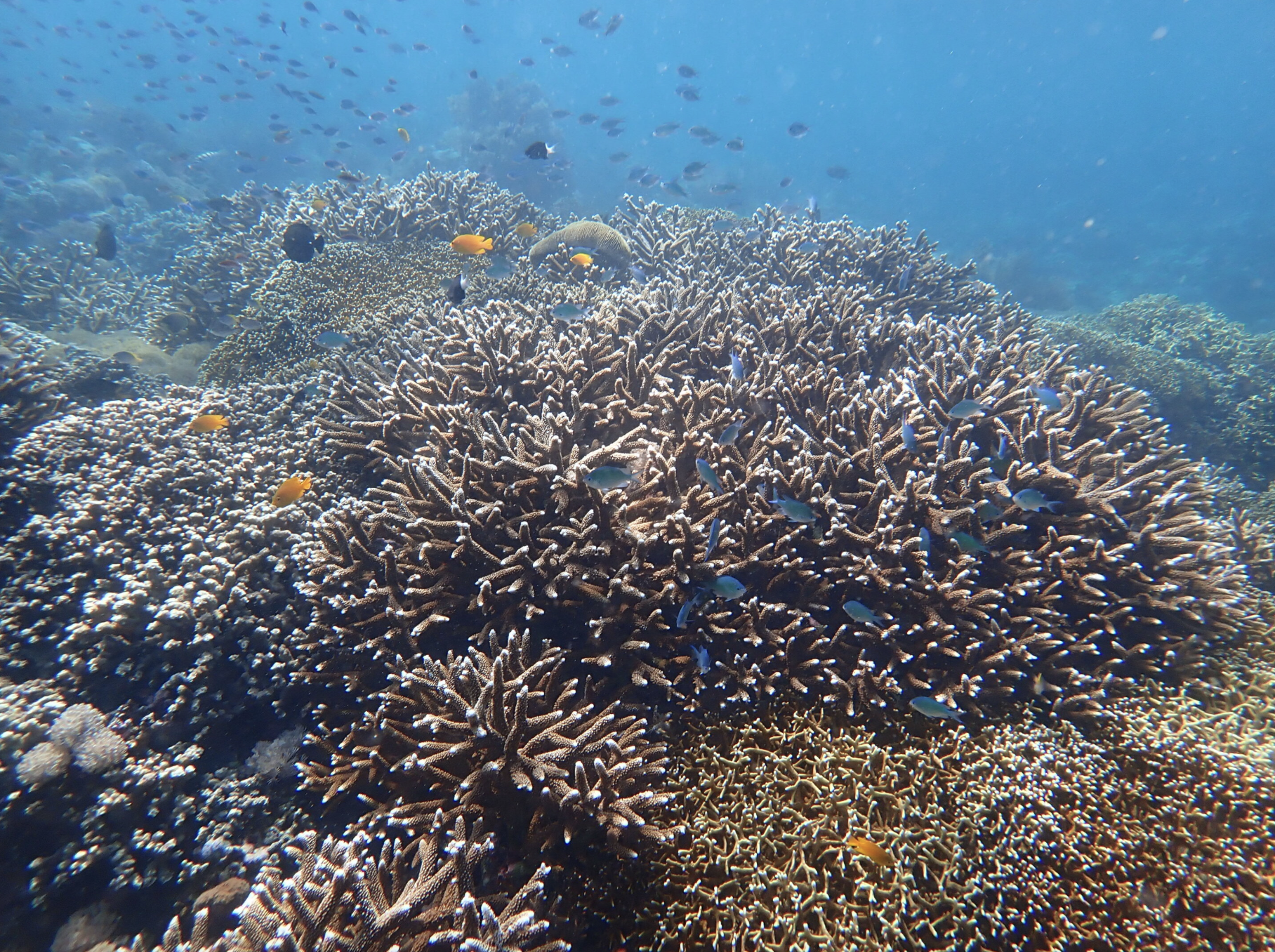
To assess how quickly reefs can realistically grow, the team compiled 288 ancient reef records from 92 sites across the Indo-Pacific, spanning the Holocene, the past roughly 11,700 years.
Layers of skeletal carbonate left behind by corals and other reef-building organisms allowed researchers to reconstruct historical growth rates for entire reef structures, rather than individual coral colonies.
“An individual coral can grow relatively quickly, but that does not mean an entire reef will build upward at the same rate,” said Ramos. “Reef cores can show us how much structure was preserved after accounting for growth, erosion and other natural processes, which then provides a more realistic measure of whether reefs can keep pace with future sea-level rise.”
The study also found that the type of coral present affects how fast a reef can build. Ancient reefs were dominated by competitive corals capable of producing large, complex structures. Many reefs today are increasingly dominated by smaller, disturbance-tolerant corals – often described as “weedy” species – which can recolonise damaged reefs quickly but do not build structure as extensively, further limiting reefs’ ability to keep pace with rising seas.
Marine heatwaves, coral bleaching, ocean acidification and pollution may compound the problem, the researchers said.
Reducing local pressures such as pollution, overfishing and physical damage could help reefs sustain healthy coral communities, but researchers also emphasised that local conservation efforts cannot fully offset the impact if sea levels rise faster than reefs are able to grow.


"*" indicates required fields
Printed editions
Current issue
Back issues


Enjoy so much more from Oceanographic Magazine by becoming a subscriber.
A range of subscription options are available.
