Killer whales are massaging one another with kelp grooming kits
It’s been hailed the first evidence of tool-making among marine mammals; observations made by researchers at the Centre for Whale Research, who have witnessed killer whales bite the end off a kelp stalk and use it as a tool for relaxation.

Towards the end of last year, they were making the headlines for wearing ‘salmon hats’, this year the in vogue behaviour for killer whales – it would appear – is to massage each other with lengths of seaweed.
It’s been hailed as the first evidence of tool-making among marine mammals; observations made by researchers at the Centre for Whale Research and the University of Exeter, who have witnessed killer whales bite the end off a kelp stalk and use it as a tool for a moment of shared relaxation.
According to those observations, these orca have been spotted positioning the kelp between themselves and a partner and rolling the kelp between their bodies for prolonged periods of time.
The behaviour was first spotted via drone footage of ‘southern resident’ killer whales in the Salish Sea, the inland waters of Washington USA. A this time, whales of all ages were observed carrying out this behaviour, possibly – researchers have positioned – to ‘strengthen social bonds and promote skin health.’
“We were amazed when we first noticed this behaviour,” said Dr Michael Weiss, research director at the Centre for Whale Research (CWR).
Several whales species are known to engage in something called ‘kelping’: the act of moving kelp with their heads, fins, and bodies – likely for play or, possibly, to remove parasites and maintain healthy skin. This new discovery, however (dubbed allokelping) is different because the kelp is first selected and then trimmed before being manipulated by two whales working together.
“Bull kelp stalk is firm but flexible, like a filled garden hose, with a slippery outer surface,” said Dr Weiss. “I suspect these features make it an ideal grooming tool. But what I find remarkable about this behaviour is just how widespread it is in the population. Males and females of all life stages and from all three southern resident pods were seen using kelp in this way. All evidence points to it being an important part of their social lives.”
The team observed ‘allokelping’ on eight out of 12 days included in the study. Based on these observations, they suspect that this behaviour may be universal in this population. Whales are also most likely to pair up to allokelp with close maternal relatives and those of similar age.
“This population of wales has been formally studied for 50 years – the best-studied orcas on the planet – and yet, major new discoveries can still be made,” said Rachel John, a Masters student studying animal behaviour at the University of Exeter.
“We hadn’t noticed ‘allokelping’ before because the videos being collected from our previous aircraft weren’t of high enough quality, but the footage we’re getting now shows this behaviour in great detail.”
In other news



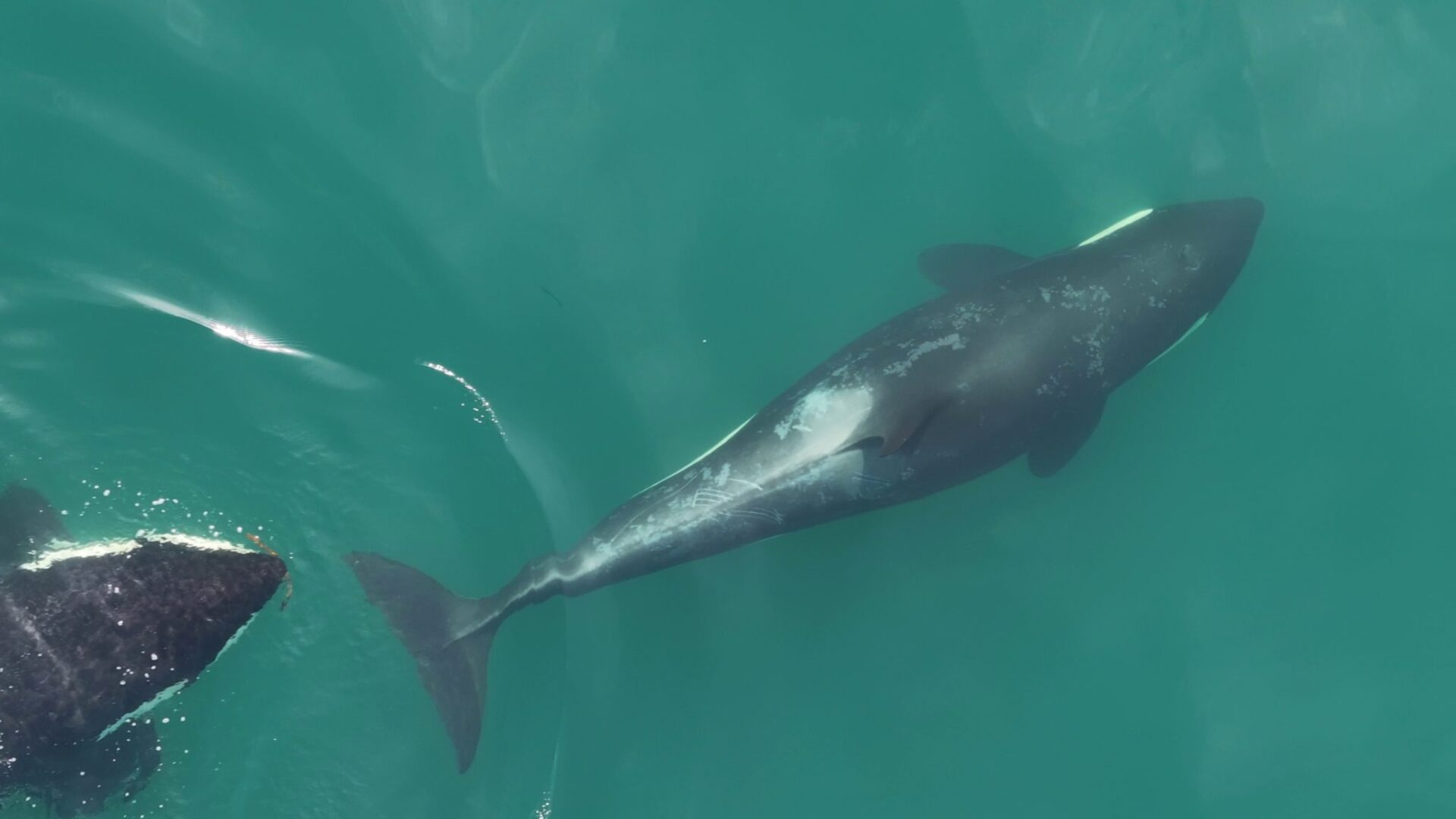
Whether it’s enhancing the experience of connecting through touch with one another or for promoting skin health by sloughing dead skin from their bodies, researchers behind the observations have proposed multiple theories behind the behaviour.
Other killer whales are known to rub their bodies on smooth stone beaches, possibly to remove dead skin and parasites. The southern resident whales have not yet been observed doing this.
“We’re now working on more research to confirm these initial findings and investigate the social and skin health benefits of this behaviour,” said Professor Darren Croft of the University of Exeter and CWR’s executive director.
The Canadian government now protects beaches where northern resident killer whales beach rub, and – with bull kelp declining due to warming water temperatures – similar protection might be needed for southern residents.
As of CWR’s last census in July 2024, just 73 southern resident killer whales now remain. As they don’t inter-breed with other killer whale populations, this number is critically low.
They feed primarily on Chinook salmon, whose numbers have also declined dramatically due to factors including overfishing, climate change, and spawning habitat destruction. The whales are also affected by pollution and noise from human activities.
Dr Weiss said that unless major changes are made, the outlook for southern resident killer whales is “very bleak”.
“We’re not seeing the birth rate that’s required to sustain the population. Under the status quo, all of our projections indicate the population will continue to decline,” he said. “They are struggling to find enough of the large, fatty Chinook salmon they need to survive and successfully rear their young.
“We often think of biodiversity in terms of protecting phenotypic variation we see in animal populations – such as differences in size, shape, and colour. However, conserving cultural and behavioural variation may be just as important.
“Allokelping is yet another piece of evidence of the southern residents’ uniqueness. If we lose them, we lose so much more than 73 individual animals or a genetic lineage. We lose a complex society and a deep, unique set of cultural traditions.”
Professor Croft, added: “These new results highlight a potential additional threat to the future survival of the southern resident killer whales: the kelp forests where they select their grooming tools are in decline due to rising ocean temperatures associated with global warming.
“Protecting the future of these kelp forests, where the killer whales make their tools, may be important in preserving this unique culture and ensuring the southern resident killer whale population continues for generations to come.”
The research paper – ‘Wild killer whales manufacture and use allogrooming tools’ – has been published in the scientific journal Current Biology.


"*" indicates required fields
Printed editions
Current issue
Back issues


Enjoy so much more from Oceanographic Magazine by becoming a subscriber.
A range of subscription options are available.
