Trump administration dismantles critical ocean-floor observation network
In line with Project 2025’s recommendations, over 900 advanced deep-sea sensors are being removed from the ocean floor, cutting off critical real-time data used by global researchers to track climate change.
The Trump administration is dismantling a $370 million ocean-floor observatory network installed a decade ago to collect critical climate data on coastal environments, marine ecosystems, and powerful global ocean currents.
The National Science Foundation (NSF) announced it will begin removing more than 900 deep-sea instruments this June. The decommissioning will pull monitoring hardware from the waters of Oregon, Washington State, Alaska, North Carolina, and a critical region between Greenland and Iceland known as the Irminger Sea.
The Ocean Observatories Initiative (OOI) began full operations in 2016. The monitoring system was engineered to provide continuous, real-time climate data to global researchers for 25 years.
Jim Edson, a marine meteorologist who led the initiative, described the network as “the world’s most advanced continuously operating ocean observing systems.”
The closure of this climate data network follows policy laid out by conservative strategist the Heritage Foundation. The shutdown was recommended in their Project 2025 “Mandate for Leadership” document – a 900-page document designed specifically to act as a blueprint for the Trump presidency.
In 2024, Project 2025’s authors explicitly targeted the network, claiming the OOI was “the source of much of NOAA’s climate alarmism” and advising that “the preponderance of its climate-change research should be disbanded.”
Since taking office, Trump’s administration has consistently targeted the network’s budget, and proposed 80% funding cuts in both 2025 and 2026. While Congress successfully pushed back on both occasions to restore the necessary money, the NSF moved ahead with decommissioning, despite managers previously attempting to save the network by limiting data collection to cut costs.

In other news



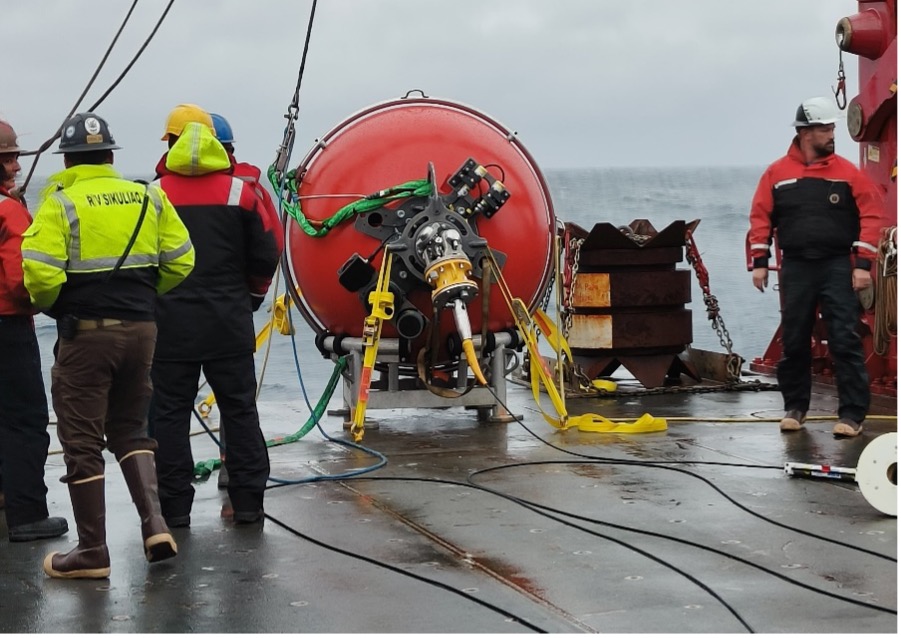
To date, the OOI system has provided critical data used to understand how the ocean absorbs atmospheric greenhouse gases, how marine heat waves threaten commercial fisheries, and how sea levels trigger coastal flooding along the East Coast.
Fixed 2,800 metres below the surface, the Irminger Sea moorings have been crucial to tracking dangerous changes occurring in the Atlantic Meridional Overturning Current (AMOC), a global current system that scientists fear could be destabilising.
Moorings stretching west off Newport, Ore, and Grays Harbor, Wash, captured data about temperature, acidity and oxygen data used by the commercial fishing industry to anticipate devastating environmental shifts.
The infrastructure cost $370 million to build, but required $48 million annually to maintain.
The network’s high-tech design featured heavily hardened instruments built to withstand extreme deep-sea pressure, corrosive seawater, and withstand destruction from marine life.
By using remotely controlled robotic vehicles and underwater gliders to beam data directly back to labs onshore, the network allowed scientists to safely collect large amounts of information without launching risky, difficult, and expensive deep-sea boat expeditions every year.
Dr Helen Palevsky, professor of earth and environmental sciences at Boston college, has used data from the OOI’s observation network to better understand how the ocean absorbs carbon dioxide.
She told the New York Times that: “One of the real tragedies here is that collecting data effectively at this site was a huge engineering challenge, and it’s not the kind of thing where you can just leave your notes for the next person who comes in, there’s a lot of expertise that has the potential to be lost.”
The dismantling is the latest escalation in a broader effort by the administration to scale back federal climate science. Just last month, the administration announced an additional $1.1 billion in budget cuts targeting research on marine wildlife, ocean currents, and fish populations.
Both international and American scientists have criticised the decision to decommission the network.
Craig McLean, who served as the chief scientist at the National Oceanic and Atmospheric Administration (NOAA) during Trump’s first term said: “This reflects the further lack of understanding that the current administration has of scientific value and scientific merit,”
“By dismantling such a system, we push the United States back yet again into a rear seat in global scientific leadership,” he added.
Professor Helen Findlay, a biological oceanographer at the Plymouth Marine Labortary criticised the decision and said: “Sustained ocean observations are how we detect emerging risks in real time, from shifts in circulation to changes in chemistry and ecosystem health. Without them, we are effectively choosing to navigate an increasingly volatile ocean with diminishing visibility.”
“Scaling back the very systems that help us track these shifts risks leaving society unprepared for their consequences. If anything, this moment should strengthen, not weaken, our commitment to sustained ocean observation and climate research,” she added.


"*" indicates required fields
Printed editions
Current issue
Back issues




Enjoy so much more from Oceanographic Magazine by becoming a subscriber.
A range of subscription options are available.
